


Osgood-Schlatter Disease: Growing Pains That Are Actually a Growth Plate Injury
Osgood-Schlatter disease, also called tibial tuberosity apophysitis, is a painful irritation of the growth plate where the patellar tendon attaches to the shinbone, just below the kneecap. Children and adolescents have soft growth plates — areas where bone is still developing — that are considerably weaker than mature bone, making them more vulnerable to this kind of overuse injury during periods of rapid growth.
Up to 10% of adolescents are affected. It’s most common during growth spurts in athletes who play running and jumping sports — soccer, basketball, gymnastics, and track are frequently involved — though less active kids can develop it too. The repeated pull of the quadriceps through the patellar tendon, right at the point where it anchors to the still-developing growth plate, is what drives the irritation.
Typical symptoms:
- Pain and tenderness directly over the bony bump below the kneecap (the tibial tuberosity)
- Pain that worsens with running, jumping, squatting, and climbing stairs
- A visibly enlarged or prominent bump at the tibial tuberosity in more established cases
- Usually affects one knee, though both can be involved
The good news: Osgood-Schlatter disease is self-limiting — it resolves once the growth plate matures and closes, typically in the mid-to-late teens. Continued participation in activity, kept within a tolerable pain level, does not cause long-term damage to the knee.
What the Research Actually Shows — Being Honest About the Gap
We think this is worth being genuinely straightforward about. A 2021 systematic review (Neuhaus, Appenzeller-Herzog, and Faude, Physical Therapy in Sport) looked specifically at the evidence for conservative treatment of Osgood-Schlatter disease and found that formal randomized controlled trial evidence is remarkably thin — only two RCTs exist in the entire literature, and both investigated injection therapy rather than the exercise and activity-modification approaches used in most clinics, including ours. The review found no controlled evidence specifically evaluating exercise programs for this condition, despite exercise-based management being the near-universal standard of care recommended by essentially every major orthopedic and sports medicine organization.
This isn’t a reason to think conservative care doesn’t work — the clinical experience and consensus recommendation behind it is extensive, and it remains the right first approach. It’s more a reflection of how research funding and interest tend to concentrate on conditions with clearer surgical or pharmaceutical treatment pathways, leaving a self-limiting pediatric condition like this one under-studied relative to how common it is. We’d rather tell you honestly that the formal evidence base is sparse than imply a level of certainty the research doesn’t actually support.
The Movement and Foot Mechanics Piece
Beyond rest and general strengthening, how a young athlete actually moves — running, jumping, and even ordinary walking — plays a real role in how much stress reaches the tibial tuberosity growth plate in the first place. Dr. Wilson evaluates this through a Postural Restoration Institute (PRI) lens, looking specifically at whether a young athlete has full, balanced access to normal triplanar motion (movement in all three planes) on both sides of the body, or whether one side is compensating for the other. When one side is chronically overloaded relative to the other, the patellar tendon on that side ends up absorbing more repetitive force with every stride or jump — directly increasing the traction on the growth plate that drives this condition.
The feet are a major, frequently overlooked part of this picture. Weak feet and excessive pronation (the foot rolling inward) change how force travels up through the leg, and in our experience, this pattern directly contributes to overloading the patellar tendon — precisely the structure pulling on the tibial tuberosity in Osgood-Schlatter disease. Addressing foot strength and mechanics, along with making sure your child is in appropriate, supportive footwear, is often an underappreciated piece of getting lasting relief rather than just symptom management. Restoring genuine, balanced movement — rather than training one already-dominant side even harder — is often the difference between symptoms that keep recurring and a resolution that actually holds.
How We Treat It
- Activity modification — not necessarily complete rest, but adjusting the type and intensity of activity to keep symptoms at a tolerable level while the growth plate matures.
- Chiropractic care and physical therapy address the surrounding musculature — particularly the quadriceps, hamstrings, and hip muscles — since imbalances here contribute to the tension being transmitted through the patellar tendon.
- Massage therapy can help manage the muscle tightness commonly seen around the knee and thigh in active young athletes.
- Ice and home care — applied after activity to manage symptoms, along with appropriate footwear and, in some cases, a patellar tendon strap or kneepad for sports.
Surgery is very rarely needed and is generally reserved for skeletally mature patients whose symptoms persist after the growth plate has closed.
FAQ
Should my child stop playing sports entirely? Usually not. Most kids with mild Osgood-Schlatter can continue their sport as long as symptoms stay at a tolerable level and don’t significantly worsen with activity. More significant cases may need a period of reduced activity, but complete, prolonged rest generally isn’t necessary or recommended.
Will this cause permanent damage to my child’s knee? No. Osgood-Schlatter disease is self-limiting and resolves once the growth plate fully matures, typically in the mid-to-late teens. Continued participation in sports at a tolerable pain level does not cause long-term knee damage.
Why does the treatment approach feel a little uncertain compared to other conditions? Because the formal research base genuinely is thinner here than for many other conditions — a 2021 systematic review found almost no controlled trials on exercise-based treatment for this specific condition, despite it being extremely common and universally treated with activity modification and physical therapy in clinical practice. We think you deserve that honest context rather than an overstated claim.
How long does Osgood-Schlatter disease typically last? This varies significantly by individual, but symptoms commonly persist, off and on, for months to a couple of years until the growth plate closes. The bony prominence at the tibial tuberosity can remain permanently even after the pain resolves — this is a cosmetic change, not an ongoing problem.
Is the bump on my child’s shin dangerous? No. The bony prominence is a normal, benign finding associated with this condition and doesn’t indicate ongoing damage. It may remain visible into adulthood even after all symptoms have resolved.
Does my child’s running form or foot mechanics matter? Yes, more than many families realize. Weak feet and excessive inward rolling of the foot (overpronation) change how force travels up the leg and can directly increase the load on the patellar tendon — the same structure pulling on the growth plate in this condition. A movement assessment that looks at whether both sides of the body are moving in a balanced way, along with proper footwear, is often an important piece of getting lasting relief rather than just managing symptoms.
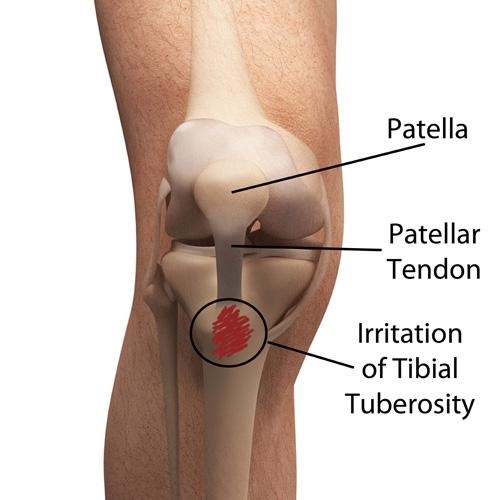
Image on this page provided by ChiroUp.
Coordinated Care, Under One Roof
Chiropractic, physical therapy, acupuncture, and massage therapy are coordinated under one roof with the rest of your treatment plan rather than operating in isolation. Schedule your appointment to get started.