


Thoracic Outlet Syndrome: What It Is and What Actually Helps
The “thoracic outlet” is the space at the base of your neck, just above the collarbone, where important nerves and blood vessels pass on their way into your arm. When these structures get compressed — most often by tight neck and chest muscles, a too-narrow space between the first rib and collarbone, or an anatomical variant like an extra cervical rib — the result is thoracic outlet syndrome (TOS): pain, numbness, tingling, or weakness in the arm and hand.
Who’s at risk: TOS is aggravated by poor posture and by occupations that promote slouching — computer users, assembly line workers, students. It’s also common in swimmers, volleyball players, tennis players, baseball pitchers, and occupations involving prolonged overhead activity like electrical work and painting. A recent neck injury or the presence of a cervical rib increases susceptibility.
Typical symptoms: Arm pain, numbness, tingling, and possible weakness, often aggravated by raising the arms or excessive head movement. Grip strength loss can occur in more established cases.
What the Research Actually Shows
The vast majority of TOS cases are the neurogenic type (compression of the brachial plexus nerves rather than blood vessels), and physical therapy is the accepted first-line treatment. We think it’s worth being straightforward about what the evidence does and doesn’t show here.
A 2025 outcomes study tracking NCAA Division 1 athletes with neurogenic TOS found that with physical therapy as the primary treatment, 79.7% experienced complete symptom resolution and another 20% had partial resolution — with 96.2% of cases managed without surgery at all, and 95% of athletes returning to competition at their prior level. That’s a genuinely strong result for a conservative-first approach.
At the same time, a 2026 scoping review of the broader NTOS rehabilitation literature was more cautious, noting the overall evidence base for physical therapy in TOS remains limited in quality, and that 60–70% of patients with neurogenic TOS end up pursuing surgery, often out of dissatisfaction with how conservative care was managed rather than because conservative care can’t work. An earlier study following 50 patients through a structured 6-month therapeutic exercise program found 34% achieved full recovery and another 28% had marked improvement — meaningful numbers, but not universal, and slower than many patients expect.
What this tells us clinically: conservative treatment for TOS works well for many patients, but the quality and structure of that conservative care matters enormously — a generic stretching handout is a different thing entirely from a properly sequenced, TOS-specific program. That’s the gap we aim to close by combining chiropractic, physical therapy, massage, and acupuncture under one coordinated plan rather than treating this as a single-modality problem.
How We Approach It
- Chiropractic care addresses joint restriction in the cervical spine, upper back, and first rib — when these are contributing to the compression, restoring their mobility creates more room in the thoracic outlet.
- Physical therapy rebuilds postural and scapular strength and corrects the movement patterns — often related to prolonged sitting or repetitive overhead motion — that narrow the space over time. This is the component the research most directly supports.
- Massage therapy targets the scalene and pectoralis minor muscles specifically, since tightness here is one of the most common direct contributors to nerve compression.
- Acupuncture can help calm nerve irritation and reduce muscle tension as an adjunct, particularly for patients who haven’t tolerated other modalities well.
Practical steps that help in the meantime: avoid carrying heavy loads on the affected shoulder, lighten laptop bags and briefcases, and consider whether bra straps need additional padding or a switch to a sports bra style — small changes that reduce ongoing compression while treatment takes effect.
FAQ
How long does treatment take to work? Based on the research and our clinical experience, most patients notice initial improvement within several weeks of starting a properly structured program, with continued improvement over 2 to 3 months. The athletic outcomes data suggests strong results are achievable, but full resolution can take longer for non-athletic, more chronic presentations.
Do I need imaging or nerve testing? Not always as a starting point. Neurogenic TOS is often diagnosed clinically through history and specific provocative tests. Imaging or electrodiagnostic studies become more relevant if red-flag symptoms are present (significant swelling, color changes in the hand, or vascular symptoms) or if conservative treatment isn’t producing the expected response.
Will I eventually need surgery? Most people don’t. Surgery is generally reserved for cases that don’t respond adequately to a genuine trial of well-structured conservative care, or for the less common vascular forms of TOS that involve blood vessel compression rather than nerve compression. We’ll be honest with you early if your presentation looks like one that may need a surgical consultation.
Can I keep exercising or playing sports during treatment? Often yes, with modifications. The athletic outcomes data specifically involved athletes continuing to train and compete throughout their rehabilitation. We’ll guide you on which movements to modify or temporarily avoid based on your specific presentation.
Is TOS the same as a pinched nerve in the neck? Related, but not the same. A cervical disc or joint issue compresses a nerve root as it exits the spine; TOS compresses the nerves further downstream, after they’ve already exited the spine and formed the brachial plexus, typically between the scalene muscles, the collarbone and first rib, or under the pectoralis minor. The symptoms can feel similar, which is part of why an accurate evaluation matters.
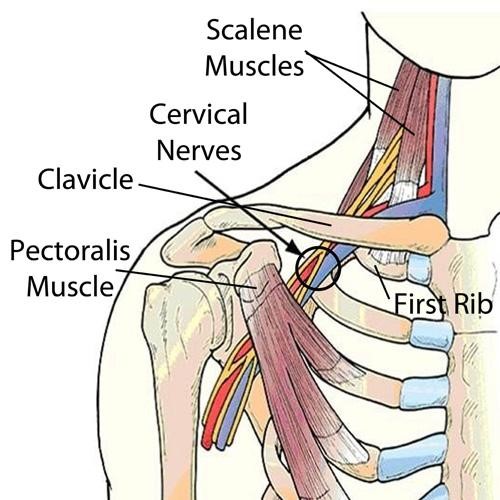
Image on this page provided by ChiroUp.
Coordinated Care, Under One Roof
Chiropractic care, physical therapy, acupuncture, massage, shockwave therapy, and functional medicine are coordinated under one roof, so a patient who needs more than one discipline is not left to manage care between separate offices. Each provider works from the same diagnosis, in the right sequence, toward the same goal: getting you better.