


IT Band Pain (Iliotibial Band Syndrome): What’s Actually Happening
The iliotibial (IT) band is a thick band of fibrous tissue running from the crest of your hip down to your knee, formed as a continuation of the tensor fascia lata and gluteal muscles. IT band syndrome is the most common cause of lateral (outer) knee pain in runners and cyclists, accounting for roughly 10% of running injuries, and affects women about twice as often as men.
What’s actually happening isn’t what was long believed. For decades, IT band syndrome was explained as a “friction syndrome” — the band rubbing back and forth over a bony bump on the outside of the knee (the lateral femoral epicondyle) as the knee bends and straightens. Anatomical studies have since shown this doesn’t hold up: the IT band doesn’t actually glide across that bony point the way the friction model assumed. The current, better-supported understanding is that IT band syndrome is a compression syndrome — repetitive compression of a richly innervated, vascular layer of fat and connective tissue sitting underneath the band, occurring at around 30 degrees of knee flexion, which corresponds almost exactly to the point in your running stride where your foot strikes the ground.
This matters for treatment, because it means stretching the band itself — the traditional advice — isn’t addressing the actual mechanism. The IT band is a thick, low-elasticity fascial structure with limited blood supply; it doesn’t meaningfully lengthen with stretching the way a muscle does.
Symptoms
- Sharp or burning pain on the outside of the knee, typically starting at a predictable point in a run or ride and forcing you to stop
- Pain that eases with rest but returns reliably at roughly the same distance or duration
- Occasional clicking or snapping sensation with knee movement
- Downhill running, worn-out shoes, and running on hard or slick surfaces are common aggravating factors
The Hip Abductor Connection
This is the piece that actually changes outcomes. The current evidence points to weakness or inhibition of the hip abductor muscles — particularly the gluteus medius — as the central biomechanical driver behind IT band syndrome. When these muscles aren’t stabilizing the pelvis properly during the single-leg stance phase of running, the leg drifts into increased hip adduction and knee valgus (an inward collapse), which increases compressive load on the IT band exactly where it becomes symptomatic.
The foundational study here (Fredericson et al., 2000, Clinical Journal of Sport Medicine) found that injured runners had measurably weaker hip abduction strength in the affected leg, and that after a 6-week hip abductor strengthening program, 22 of 24 runners returned to pain-free running with no recurrence at 6 months. It’s worth being straightforward that this was a small case series without a control group — it doesn’t definitively prove weak hips cause IT band syndrome — but it’s been replicated and built on by enough subsequent research that hip abductor strengthening is now a standard, evidence-informed part of conservative treatment, not just a theory.
This same hip abductor weakness pattern is also a well-established contributor to piriformis syndrome — if you’ve dealt with both lateral knee pain and deep buttock/sciatic-type pain, they may well share the same underlying driver.
Why It’s Usually One-Sided: Gait Timing Asymmetry
IT band syndrome is often unilateral, and there’s a reason that goes beyond simple overuse. The human body has a natural underlying asymmetry to how it moves — most people spend measurably more time in stance phase on one side (typically the right) than the other during walking and running. That extra time in contact on one foot means that side absorbs and generates more repetitive force with every stride, stride after stride, run after run.
This connects directly to the hip abductor picture above: a foot that spends more time in ground contact places more demand on that side’s hip abductors to control pelvic stability through a longer stance window. If those muscles are already underperforming, the side with the longer contact time is the side most likely to develop the compressive overload pattern that produces IT band symptoms. This is a meaningful part of why we evaluate gait timing and side-to-side loading patterns as part of a thorough workup, rather than assuming the problem is confined to the knee or even the hip in isolation — the asymmetry driving the overload often starts with how the whole gait cycle is organized, not just how strong one muscle group is.
How We Treat It
- Chiropractic care and manual therapy address the pelvic and hip mechanics contributing to abnormal loading, rather than treating the IT band as an isolated local problem.
- Physical therapy rebuilds hip abductor strength specifically — the intervention with the most direct evidence behind it — along with correcting the movement patterns that placed excess compressive load on the IT band in the first place.
- Massage therapy addresses tightness in the tensor fascia lata, gluteals, and surrounding musculature that contributes to the compression pattern.
- Acupuncture is an option for pain modulation, particularly useful in more acute or irritated presentations alongside the mechanical work above.
- Shockwave therapy is an option for chronic cases that haven’t resolved with standard conservative care. We’ve written a full breakdown of shockwave for knee-related conditions, including IT band syndrome — we’re upfront there that the evidence base for shockwave specifically in IT band syndrome is smaller than for other tendon conditions, though the biological rationale for treating the compressed, thickened tissue is sound.
FAQ
Should I keep stretching my IT band? Gentle stretching isn’t harmful, but it’s not addressing the actual mechanism — the IT band is a fascial structure that doesn’t meaningfully lengthen with stretching, and current evidence points to compression, not tightness, as the real driver. Hip abductor strengthening is the more evidence-supported focus.
Why does my IT band pain always show up at the same point in my run? This is a classic feature of the condition, and it fits the compression model well — the impingement occurs at a specific knee angle (around 30 degrees of flexion) that corresponds to a specific phase of your stride, which is why the pain tends to appear predictably at a similar distance or time each run.
How long does treatment take? Based on the research and our clinical experience, many runners see meaningful improvement within several weeks of starting a properly structured hip abductor strengthening program, though this depends on how long the pattern has been established and how consistently the program is followed.
Can I keep running while being treated? Often yes, with modifications — usually reducing mileage, avoiding downhill sections, and addressing training errors like too-rapid mileage increases while the underlying strength deficit is being corrected. We’ll guide you on the right level of activity for your specific case.
Is this the same as runner’s knee (PFPS)? No, though the two are frequently confused because both affect the knee in runners. PFPS causes diffuse pain under or around the kneecap at the front of the knee; IT band syndrome causes sharp, localized pain on the outside of the knee. The mechanisms and treatment emphasis differ, though hip abductor weakness is a contributing factor in both.
Why does IT band syndrome usually only affect one side? Most people have a natural asymmetry in how long each foot stays in contact with the ground during walking and running — one side typically spends more time in stance phase than the other. That extra ground-contact time means more repetitive load on that side’s hip and knee with every stride, which is part of why IT band syndrome so often shows up on just one leg rather than both. We evaluate this kind of side-to-side loading pattern as part of a thorough workup.
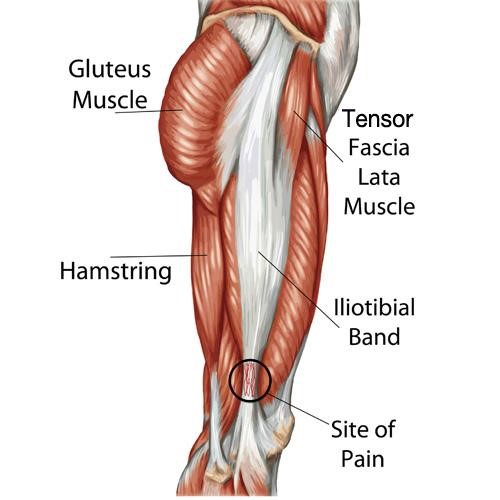
Image on this page provided by ChiroUp.
Coordinated Care, Under One Roof
Chiropractic, physical therapy, acupuncture, and massage therapy are coordinated under one roof with the rest of your treatment plan rather than operating in isolation. Schedule your appointment to get started.