


Elbow Pain: Tennis Elbow and Golfer’s Elbow
Tennis Elbow (Lateral Epicondylitis)
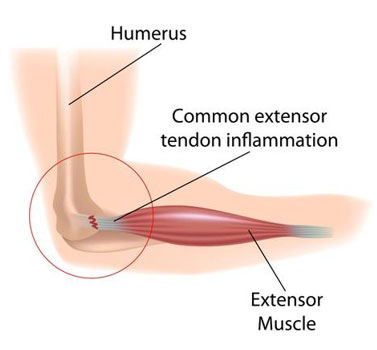
Most of the muscles that extend your wrist attach to a bony bump on the outside of your elbow called the lateral epicondyle. Through injury or overuse, the site where these muscles insert can become irritated or inflamed — a condition called lateral epicondylitis, or “tennis elbow,” although most people affected have never played tennis.
Activities involving repetitive wrist extension are the most common cause: tennis, carpentry, bricklaying, knitting, playing piano, typing, or lifting objects with your palm facing down. The condition is three times more likely to strike your dominant arm.
Typical symptoms: Pain often begins as intermittent or gradual discomfort during activity and progresses until even simple activities — holding a coffee cup, gripping a doorknob, shaking hands — become painful. Pain commonly radiates into the forearm, sometimes to the wrist.
Golfer’s Elbow (Medial Epicondylitis)
Most of the muscles that flex your wrist attach to a bony bump on the inside of your elbow called the medial epicondyle. When the site where these muscles originate becomes irritated or inflamed, it’s called medial epicondylitis, or “golfer’s elbow.”
Despite the name, over 90% of those affected aren’t golfers. The condition is more common in golf, throwing sports, bowling, football, archery, and weight lifting, as well as occupations requiring heavy gripping or repeated hand movements like carpentry or typing. Smoking and obesity increase risk.
Typical symptoms: A dull ache over the bump on the inside of the elbow that intensifies with use, most common between ages 40–60, striking the dominant arm in over three-quarters of cases. As it progresses, grip weakness can develop — trouble shaking hands, grasping objects, or opening jars.
Left untreated, medial epicondylitis can persist indefinitely — some studies show up to 40% of untreated patients experience prolonged discomfort, occasionally for years. Conservative treatment is effective for the large majority of cases.
What the Research Shows
For tennis elbow, a large and growing body of evidence supports eccentric exercise — a specific type of muscle-lengthening strengthening exercise — as a first-line conservative treatment, often combined with other modalities. Golfer’s elbow has historically been studied far less than tennis elbow, but a 2026 systematic review (See ZH, et al., Manual Therapy) specifically evaluating eccentric exercise for medial epicondylitis found it reduced pain and improved function across the studies reviewed, particularly as part of a broader conservative treatment plan. The authors were honest that overall evidence certainty remains low and called for larger, higher-quality trials — a caveat worth knowing, though the direction of the evidence is consistently positive.
For chronic tennis elbow or golfer’s elbow that hasn’t responded to standard conservative care — particularly cases where a prior cortisone injection helped temporarily and then wore off — shockwave therapy is a genuinely strong option with a growing evidence base for both conditions. It’s one of the most effective tools we have for the chronic, stubborn cases that plateau with rest and exercise alone. We’ve written a full breakdown of why shockwave outperforms cortisone long-term for tennis elbow, including a randomized trial showing measurable structural improvement in the tendon itself, not just reported pain relief.
FAQ
Do I need to stop the activity causing my elbow pain entirely? Not always full rest, but reducing the aggravating activity is usually part of the plan while we address the underlying tendon and mechanical contributors. Complete rest without addressing what’s driving the irritation often just delays symptoms returning once you resume activity.
How do I know if it’s tennis elbow or golfer’s elbow? Location is the key distinction — tennis elbow causes pain on the outside of the elbow, golfer’s elbow on the inside. A proper evaluation confirms which tendons are involved and rules out other causes of elbow pain.
Will a cortisone shot fix this permanently? Cortisone injections often provide fast relief, but they address inflammation, not the underlying tendon changes — repeated injections also carry a real risk of weakening the tendon over time. If a previous injection helped temporarily and then the pain came back, that’s a common pattern, and shockwave therapy is specifically designed to address what cortisone can’t.
Is shockwave therapy an option for chronic elbow pain? Yes — for both tennis elbow and golfer’s elbow, shockwave therapy is one of the most effective tools we have for chronic, stubborn cases that haven’t fully resolved with rest, exercise, and standard conservative care. It’s particularly useful when a case has plateaued or when a previous cortisone injection only provided temporary relief.
How long does treatment take? This varies with chronicity, but many patients see meaningful improvement within several weeks of starting a properly structured conservative program. Cases that have been present for months or years, or that involve significant tendon degeneration, may take longer.
Can I keep playing my sport or doing my job while being treated? Often yes, with modifications. We’ll guide you on which movements to limit and how to adjust technique or ergonomics to reduce ongoing strain while treatment addresses the underlying issue.
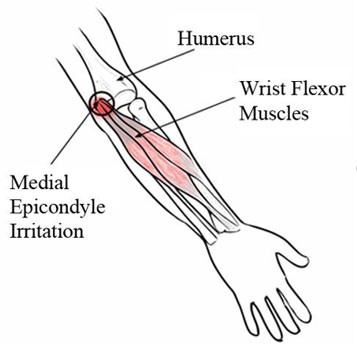
Image on this page provided by ChiroUp.
Coordinated Care, Under One Roof
Chiropractic, physical therapy, acupuncture, and massage therapy are coordinated under one roof with the rest of your treatment plan rather than operating in isolation. Schedule your appointment to get started.