


Shockwave Therapy for Tennis Elbow: Why Cortisone Works Fast But Shockwave Wins Long-Term
By Dr. Matthew Wilson, DC, FIACA | Ashworth Chiropractic, Physical Therapy & Acupuncture | West Des Moines, Iowa
Tennis elbow has one of the most misleading names in all of musculoskeletal medicine. Most people who get it have never picked up a tennis racket.
What they have done is grip, twist, type, paint, swing a hammer, work a keyboard, or do any of a hundred other repetitive things with their arm. And one day the outside of their elbow starts hurting — a sharp, nagging pain that gets worse when they grip anything, turns a handshake into a wince, and refuses to fully go away no matter how long they rest it.
If that sounds familiar, you’re in good company. Lateral epicondylitis affects roughly 1 to 3 percent of adults, and it’s one of the most under-treated conditions we see — largely because the standard treatment path leaves a lot of people better for a few weeks and then right back where they started.
Here’s what’s actually going on — and why shockwave therapy changes the outcome in a way that cortisone injections simply can’t.
What Tennis Elbow Actually Is
The lateral epicondyle is the bony bump on the outside of your elbow. Several muscles and tendons that control wrist and finger extension attach there. When those tendons are repeatedly stressed, microtears develop at the attachment point. Early on, there’s genuine inflammation — the classic “-itis” presentation.
But here’s the problem: for most people who end up in our office with tennis elbow, that inflammatory phase passed a long time ago. What they’re dealing with now is tendinopathy — a degenerative process where the tendon tissue has broken down, collagen has become disorganized, and the body has largely stopped trying to repair the area. Blood flow to the region decreases. Scar tissue builds up. The tendon loses its normal structural integrity.
This is why tennis elbow that has been around for months tends to be so stubborn. It’s not an inflammation problem anymore — it’s a repair problem. And that distinction matters enormously for how it should be treated.
💡 The defining feature of chronic tennis elbow: the tendon has stopped repairing itself. Treatments that target inflammation provide temporary relief at best. Treatments that stimulate biological repair address the actual problem.
How Shockwave Therapy Works for Tennis Elbow
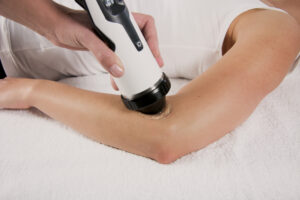
Shockwave Therapy for Elbow Pain
The Storz Medical Duolith SD1 Ultra delivers focused acoustic energy precisely to the degenerative tissue at the lateral epicondyle. The response is biological and well-documented:
- Stimulates neovascularization — new blood vessel formation — restoring circulation to tissue that has become ischemic
- Triggers collagen synthesis and tendon remodeling, replacing disorganized scar tissue with structured repair
- Breaks down calcifications that may have formed at the tendon attachment
- Reduces substance P, the primary pain-signaling neuropeptide in chronic tendon conditions
- Activates the body’s own stem cell recruitment and regenerative repair process
The result is not temporary pain suppression. It’s actual tissue repair — which is why the outcomes from shockwave therapy tend to hold up over time in a way that cortisone injections do not.
What the Clinical Research Shows
Based on articles retrieved from PubMed, here is what the peer-reviewed literature tells us — including one finding that every patient considering cortisone for their tennis elbow should hear:
Shockwave Loses at 1 Month But Wins at 3 and 6 Months vs. Cortisone
A 2024 systematic review and meta-analysis published in Orthopaedic Surgery (Zhang et al.) analyzed six randomized controlled trials directly comparing ESWT to corticosteroid injection for chronic lateral epicondylitis. The findings are striking — and worth understanding before you decide which path to take.
At 1 month, cortisone was superior — better pain scores, better grip strength, better function. That’s not surprising. Cortisone is a powerful anti-inflammatory and it works quickly.
But at 3 months, shockwave had pulled ahead — significantly better pain relief, grip strength, and functional scores compared to the cortisone group.
At 6 months, shockwave was still ahead — significantly better pain and grip strength outcomes. The cortisone group had largely regressed back toward their baseline while the shockwave group continued to hold their improvement.
Both treatments had similarly low rates of mild adverse events. Neither was dangerous. But one produced durable results and the other didn’t.
Zhang L, et al. Extracorporeal Shock Wave Therapy Versus Local Corticosteroid Injection for Chronic Lateral Epicondylitis: A Systematic Review with Meta-Analysis of Randomized Controlled Trials. Orthop Surg. 2024;16(11):2598-2607. DOI: https://doi.org/10.1111/os.14212
★ The takeaway: cortisone gets you feeling better faster. Shockwave gets you actually better — and keeps you there.
At 3 months and 6 months, patients who chose shockwave had significantly better pain relief
and grip strength than those who got cortisone injections. ★
ESWT Outperforms Ultrasound and Deep Friction Massage
A 2024 double-blind randomized clinical trial published in Scientific Reports (Perveen et al.) enrolled 80 patients with lateral epicondylitis and compared ESWT head-to-head against ultrasound therapy combined with deep friction massage — two of the most commonly used conservative treatments. At both the 3-week and 7-week marks, ESWT produced significantly better outcomes on both pain and functional measures. The between-group analysis confirmed ESWT was more effective for lateral epicondylitis than the combined conventional treatment.
Perveen W, et al. Effects of extracorporeal shockwave therapy versus ultrasonic therapy and deep friction massage in the management of lateral epicondylitis: a randomized clinical trial. Sci Rep. 2024;14(1):16535. DOI: https://doi.org/10.1038/s41598-024-67313-1
Structural Tendon Changes — Not Just Pain Relief
A randomized controlled trial published in Turkish Journal of Medical Sciences (Özmen et al.) compared ESWT, ultrasound therapy, and Kinesio taping for lateral epicondylitis and found something particularly meaningful: only the ESWT group showed a significant reduction in common extensor tendon thickness on ultrasound at 8 weeks. In other words, shockwave therapy produced measurable structural changes in the tendon itself — not just reported pain improvement. The other treatments reduced pain but didn’t change the underlying tissue pathology the same way.
Özmen T, et al. Comparison of the clinical and sonographic effects of ultrasound therapy, extracorporeal shock wave therapy, and Kinesio taping in lateral epicondylitis. Turk J Med Sci. 2021;51(1):76-83. DOI: https://doi.org/10.3906/sag-2001-79
The Honest Case Against Cortisone for Chronic Tennis Elbow
Cortisone injections are one of the most common treatments offered for tennis elbow, and in the short term they work well. The problem is what happens after.
The Zhang et al. meta-analysis puts it plainly: at 3 months, the cortisone group had regressed significantly relative to the shockwave group. By 6 months, shockwave patients had meaningfully better pain scores and grip strength. The cortisone effect, in most cases, fades.
This makes sense when you understand the mechanism. Cortisone suppresses inflammation — but chronic tennis elbow isn’t primarily driven by inflammation. The underlying issue is degenerative tendon tissue that isn’t repairing itself. Suppress the inflammatory signal and you feel better temporarily. The tendon structure itself remains compromised.
Repeated cortisone injections carry additional concerns — tendon weakening and increased risk of rupture over time. Most clinical guidelines recommend limiting injections and exploring alternatives for chronic or recurrent presentations.
If you’ve had a cortisone injection for tennis elbow and it helped for a while but then came back — shockwave therapy addresses what the cortisone couldn’t.
It’s Not Just Tennis Players
We want to say this clearly because we see it in our waiting room all the time: the overwhelming majority of people with lateral epicondylitis have never played tennis. We treat:
- Contractors and tradespeople — painters, plumbers, carpenters, electricians
- Office workers — keyboard and mouse use all day, especially with poor ergonomics
- Golfers — despite the name, golfer’s elbow is the medial side; many golfers also develop lateral epicondylitis
- Weightlifters and CrossFit athletes — repetitive gripping and pulling movements
- Parents of young children — lifting and carrying loads the arm wasn’t ready for
- Anyone who had a sudden increase in activity involving grip or wrist extension
If the outside of your elbow hurts when you grip things, shake hands, or extend your wrist — regardless of how you got there — this is worth a conversation.
What to Expect at Ashworth Clinic
We start with a thorough evaluation to confirm the diagnosis and understand how long you’ve had symptoms, what you’ve already tried, and what your functional goals are. From there, if shockwave therapy is appropriate:
- 3 to 5 focused shockwave sessions spaced 1 to 2 weeks apart
- Sessions are 5 to 15 minutes — no anesthesia, no recovery time required
- We use the Storz Medical Duolith SD1 Ultra with Sepia focused handpiece — true focused shockwave reaching the tendon at depth
- Shockwave is frequently combined with Graston Technique soft tissue work or physical therapy to address muscle imbalances and movement patterns contributing to the load on the lateral epicondyle
- No packages. Pay per session. We assess your progress each visit.
Most patients begin noticing improvement within the first 2 to 3 sessions. The structural changes the research documents — reduced tendon thickness, improved collagen organization — continue developing over the weeks following treatment as the tissue remodels.
Questions We Hear Most
I had a cortisone shot six months ago and it helped for a while. Now it’s back. Is shockwave still an option?
Yes — and this is actually one of the most common presentations we see. Prior cortisone injection doesn’t disqualify you from shockwave therapy. In fact the Zhang et al. meta-analysis was specifically conducted in patients with chronic lateral epicondylitis, many of whom had already received other treatments. Shockwave addresses the underlying tissue degeneration that the cortisone couldn’t fix.
Do I need to stop working during treatment?
Usually not. Most patients continue working through their shockwave treatment course with modifications as needed. We’ll give you specific guidance at your evaluation based on what your work involves.
What about golfer’s elbow — the inside of the elbow?
Medial epicondylitis, or golfer’s elbow, involves the same degenerative tendon process on the inside of the elbow and responds to shockwave therapy through the same mechanism. The research base is somewhat smaller than for lateral epicondylitis but the clinical outcomes are similarly positive. We treat both.
Is this covered by insurance?
Most insurance carriers don’t cover ESWT. We’re upfront about this. At $200 per session for 3 to 5 sessions, most patients find it significantly more cost-effective than a cycle of cortisone injections, ongoing therapy, and eventually surgical consultation — especially given the long-term outcome data.
If you’re ready to find out whether you’re a candidate, visit our shockwave therapy service page for full details
Clinical References
The following peer-reviewed studies were retrieved from PubMed and cited in this article.
- Zhang L, et al. Extracorporeal Shock Wave Therapy Versus Local Corticosteroid Injection for Chronic Lateral Epicondylitis: A Systematic Review with Meta-Analysis of Randomized Controlled Trials. Orthop Surg. 2024;16(11):2598-2607. DOI: https://doi.org/10.1111/os.14212
- Perveen W, et al. Effects of extracorporeal shockwave therapy versus ultrasonic therapy and deep friction massage in the management of lateral epicondylitis: a randomized clinical trial. Sci Rep. 2024;14(1):16535. DOI: https://doi.org/10.1038/s41598-024-67313-1
- Özmen T, et al. Comparison of the clinical and sonographic effects of ultrasound therapy, extracorporeal shock wave therapy, and Kinesio taping in lateral epicondylitis. Turk J Med Sci. 2021;51(1):76-83. DOI: https://doi.org/10.3906/sag-2001-79
About the Author
Dr. Matthew Wilson, DC, FIACA, CCWP is the owner and lead clinician at Ashworth Chiropractic, Physical Therapy & Acupuncture in West Des Moines, Iowa. He is a Palmer College of Chiropractic honors graduate with advanced certifications in Graston Technique, Postural Restoration, functional medicine, acupuncture, laser therapy, and dry needling. His Graston M1 certification is particularly relevant for elbow and soft tissue conditions — Graston and shockwave are frequently combined at Ashworth for optimal tendon outcomes.