


Piriformis Syndrome: What It Is and How It’s Treated
Piriformis syndrome results from compression of the sciatic nerve as it passes near — or in some people, directly through — a muscle in the buttock called the piriformis. The piriformis attaches from the lowest part of the spine (sacrum) and travels across to the hip, helping rotate the leg outward when it contracts. In most people, the sciatic nerve travels just beneath the piriformis muscle. When the piriformis becomes irritated or goes into spasm, it can compress the nerve running alongside it, producing sciatica-like pain.
Anatomical variation matters here: in roughly 15% of people, the sciatic nerve runs through or above the piriformis rather than beneath it, which predisposes those individuals to compression whenever the muscle becomes tight or overactive.
Piriformis syndrome can begin suddenly from an injury or develop gradually from repeated irritation — often without a specific triggering event a patient can point to. It’s most common in adults 40–60 years old and affects women more often than men.
Typical symptoms:
- Pain, numbness, or tingling starting in the buttock and radiating along the sciatic nerve toward the foot
- Symptoms that worsen with sitting or standing in one position for more than 15–20 minutes (changing position often helps)
- Increased symptoms with walking, running, climbing stairs, riding in a car, sitting cross-legged, or rising from a chair
Piriformis-related sciatica is one of the more treatable forms of sciatica, and it responds well to the conservative approaches described below.
The Hip Abductor Connection
Piriformis syndrome rarely occurs in isolation. The piriformis works alongside the hip abductors — particularly the gluteus medius — to stabilize the pelvis during single-leg movement like walking. When the gluteus medius is weak or inhibited, the piriformis often compensates by working harder than it should, becoming chronically overactive and irritated as a result. This is why a thorough evaluation for piriformis syndrome typically includes assessment of hip abductor strength, not just the piriformis itself — treating the tight muscle without addressing the weak one it’s compensating for tends to produce results that don’t hold.
Why Piriformis Syndrome Responds Well to a PRI-Based Approach
Piriformis syndrome is one of the conditions that responds particularly well to a Postural Restoration Institute (PRI)-informed evaluation, and there’s a clear reason why. The piriformis is a hip external rotator — and in the postural asymmetry patterns PRI addresses, one side of the pelvis is very commonly stuck in a position that keeps the corresponding hip external rotators, including the piriformis, chronically short and overactive. This isn’t a coincidence or a one-off finding; it’s a predictable consequence of how the pelvis and hip typically load asymmetrically.
Dr. Wilson has completed the full PRI curriculum and sits for the Postural Restoration Certified (PRC) examination in December 2026. In his clinical experience, patients whose piriformis syndrome is evaluated through this lens — identifying the specific pelvic and hip pattern driving the piriformis to overwork, rather than treating the piriformis as an isolated local problem — tend to see more complete and more lasting resolution than with local treatment alone. This ties directly into the hip abductor connection above: the same asymmetrical loading pattern that inhibits the gluteus medius on one side is often what’s simultaneously overworking the piriformis.
What the Research Shows
A 2026 systematic review in the Indian Journal of Orthopaedics found that conservative manual therapies — myofascial release, active release technique, and manual manipulation — showed meaningful clinical potential for managing piriformis syndrome, with several studies suggesting these approaches produce greater improvement than stretching alone. The review’s authors noted that combining manual therapy with targeted strengthening exercises appears to provide better outcomes than either approach used in isolation — consistent with the hip abductor connection described above.
An earlier foundational review (Hopayian et al., 2010, European Spine Journal) established the diagnostic and clinical framework most providers still use today, noting that piriformis syndrome is a clinical diagnosis — based on history and physical examination — rather than one confirmed by a single definitive test.
How We Treat It
- Chiropractic care and manual therapy — including myofascial release and manipulation techniques directed at the piriformis and surrounding gluteal muscles
- Physical therapy — addressing hip abductor strength and pelvic stability, the mechanical driver behind much piriformis overactivation
- Massage therapy — targeted soft tissue work to reduce tension and trigger points in the piriformis and deep gluteal muscles
- Acupuncture — an option for pain modulation, particularly for patients whose symptoms haven’t fully resolved with manual therapy alone
FAQ
How is piriformis syndrome different from sciatica caused by a disc problem? Both can produce similar symptoms — pain radiating from the buttock down the leg — but the source is different. Disc-related sciatica originates at the spine, from a herniated disc compressing a nerve root. Piriformis syndrome occurs further downstream, where the sciatic nerve passes near the piriformis muscle in the buttock. A thorough evaluation, including specific orthopedic tests, helps distinguish between the two, since the treatment approach differs.
Why does my piriformis keep tightening up even after treatment helps? This is usually a sign that something else is driving the piriformis to overwork — most commonly weak or underactive hip abductors that aren’t stabilizing the pelvis the way they should. Addressing the piriformis directly provides relief, but if the underlying weakness isn’t corrected, the piriformis tends to return to its overactive, compensatory pattern.
What does a PRI-based evaluation look at for piriformis syndrome? It looks at the pelvic and hip postural pattern that’s causing the piriformis to work harder than it should in the first place — rather than treating the piriformis as an isolated problem. Piriformis syndrome tends to respond particularly well to this approach, since the muscle’s overactivity is frequently a predictable consequence of a specific, identifiable pelvic asymmetry pattern rather than a random local irritation.
Will I need imaging to diagnose piriformis syndrome? Not usually. Piriformis syndrome is diagnosed clinically, through history and specific physical examination tests, rather than through imaging. Imaging becomes more relevant if your presentation doesn’t fit the typical pattern, or if we need to rule out a spinal source for your symptoms.
How long does treatment take? Piriformis-related sciatica is one of the more treatable forms of sciatica, and many patients notice meaningful improvement within several visits. Cases involving significant hip abductor weakness that needs to be rebuilt may take longer to fully resolve.
Can I stretch it out myself? Gentle piriformis stretching can help, but self-stretching alone often doesn’t address the underlying hip abductor weakness that’s frequently driving the problem. If stretching hasn’t provided lasting relief, that’s usually the missing piece.
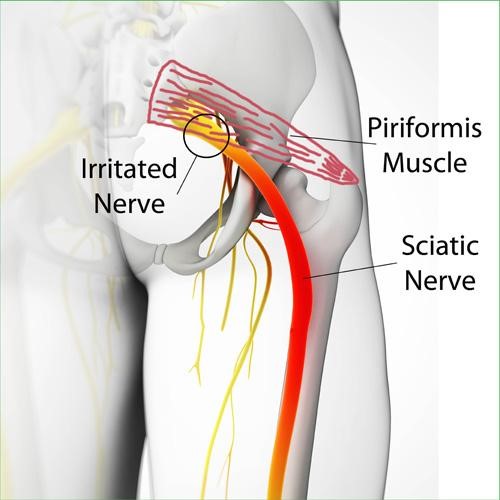
Image on this page provided by ChiroUp.
Coordinated Care, Under One Roof
Chiropractic, physical therapy, acupuncture, and massage therapy are coordinated under one roof with the rest of your treatment plan rather than operating in isolation. Schedule your appointment to get started.