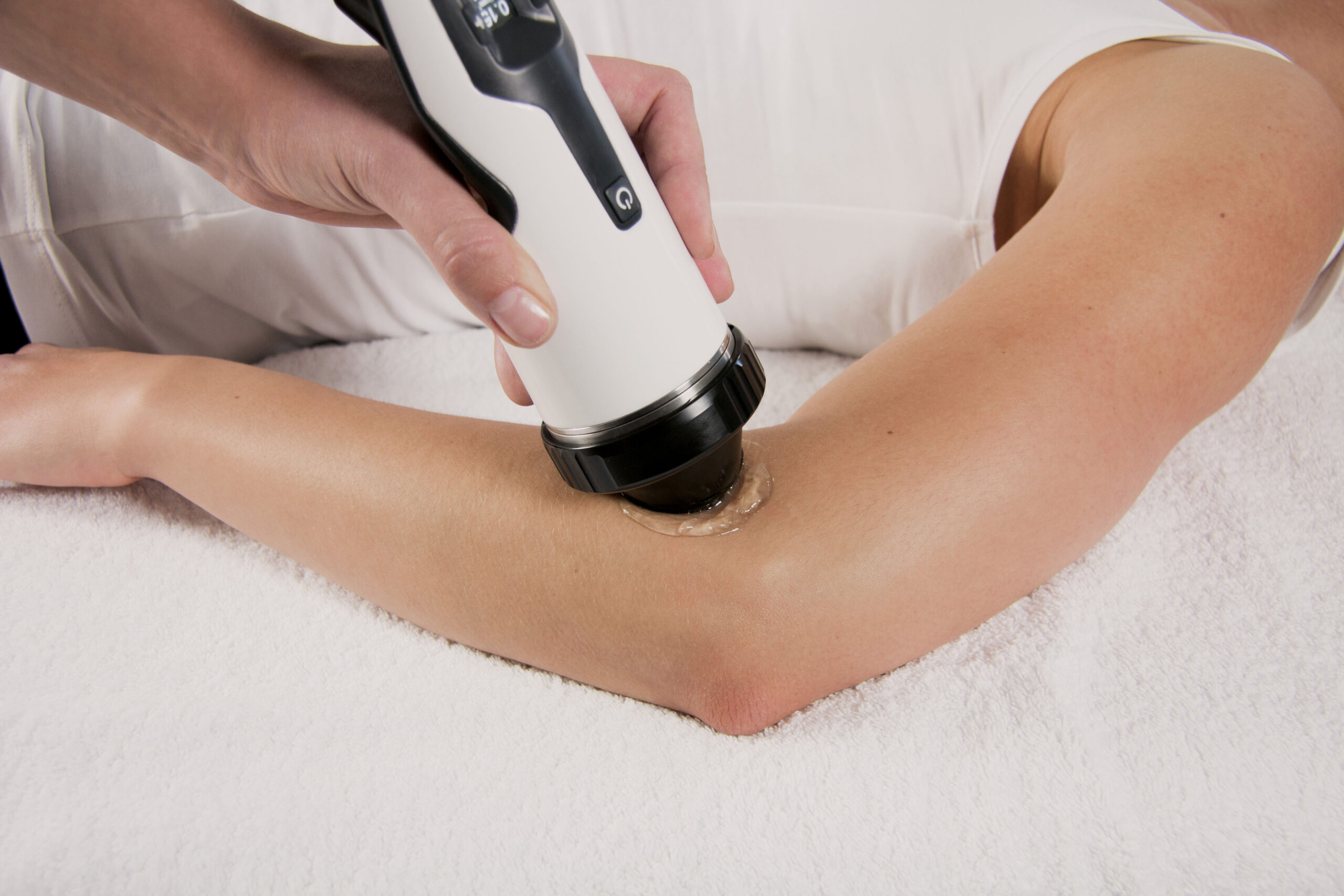

Shockwave Therapy for Golfer’s Elbow
Golfer’s elbow — medial epicondylitis — is a painful degeneration of the tendons on the inside of the elbow, where the forearm’s wrist-flexor muscles attach. It’s caused by the same kind of repetitive overload that drives tennis elbow, just affecting the opposite side of the elbow.
Being Honest About the Evidence Here
We’ve written extensively about shockwave therapy for tennis elbow, where the research is genuinely robust — multiple randomized controlled trials and systematic reviews consistently support ESWT as an effective option, particularly for cases that haven’t responded to standard conservative care.
Golfer’s elbow is a different picture, and we want to be direct about that rather than assume the tennis elbow evidence simply carries over. A 1998 comparative study (Krischek et al., published in Zeitschrift für Orthopädie und ihre Grenzgebiete) treated 30 patients with chronic golfer’s elbow and 30 patients with chronic tennis elbow using an identical shockwave protocol, then compared outcomes directly. The results diverged meaningfully: only 27% of golfer’s elbow patients had a good or excellent outcome, compared to 60% of tennis elbow patients treated the exact same way. That’s a real, same-protocol comparison showing shockwave performing notably less reliably for medial epicondylitis than for lateral epicondylitis.
More recent research has found real benefit from shockwave for golfer’s elbow specifically — it isn’t ineffective — but a 2024 randomized controlled trial comparing platelet-rich plasma (PRP) injection against shockwave therapy for medial epicondylitis found both groups improved through 12 and 24 weeks, but the PRP group showed superior improvement by the 6-month mark. It’s a genuinely well-designed study, but worth noting it compared PRP against shockwave used alone — not really an apples-to-apples comparison with how we actually treat golfer’s elbow here, since shockwave is one tool in a broader combined approach rather than a standalone treatment in this clinic.
What We’re Actually Seeing in This Clinic
The shockwave-alone literature above doesn’t tell the whole story of how we treat golfer’s elbow here. Shockwave is one piece of a broader combined approach — paired with manual therapy, laser therapy, and home care exercises — not a standalone treatment. Across our own outcomes tracking, 7 golfer’s elbow cases averaged 80% improvement in just 2.0 visits, compared to a national benchmark of 81% improvement over an average of 7.0 visits. We’re upfront that this is a small sample, and we wouldn’t want you to read a guaranteed result into 7 cases — but it’s a real, meaningful signal that combining these approaches, rather than relying on any single tool in isolation, is what produces results well beyond what the shockwave-alone research would predict.
What This Means for Your Treatment
The published literature alone doesn’t support the same level of confidence in shockwave for golfer’s elbow that we have for tennis elbow — but our own outcomes suggest that shockwave combined with chiropractic care and manual therapy, rather than used alone, is where golfer’s elbow treatment actually earns its results in this clinic. If you’re dealing with chronic, stubborn golfer’s elbow that hasn’t responded to standard conservative care, it’s worth a direct conversation about how we’d combine these approaches for you specifically, including where PRP might fit if shockwave and manual therapy together aren’t enough.
How We Treat It
- Chiropractic care and manual therapy address the wrist, forearm, elbow, and shoulder mechanics contributing to the repetitive strain pattern.
- Physical therapy builds a structured eccentric loading program — the intervention with the most consistent evidence behind it for epicondylitis generally.
- Laser therapy supports the healing tissue environment alongside the mechanical treatment above.
- Shockwave therapy is available as an option for chronic cases, with the honest evidence picture above factored into whether and when we recommend it for you specifically.
- Home care exercises reinforce what’s being addressed in-office, which is part of why our combined approach produces results in fewer visits than relying on any single treatment alone.
FAQ
Is shockwave as effective for golfer’s elbow as it is for tennis elbow? Not based on the published research alone — a same-protocol comparative study found notably lower success rates for golfer’s elbow (27% good/excellent) than tennis elbow (60%) in the same patients. That said, our own clinic outcomes, using shockwave combined with laser therapy, manual therapy, and home care exercises rather than shockwave alone, have been considerably stronger than the shockwave-only literature would predict.
Should I get PRP instead of shockwave for golfer’s elbow? It depends on your specific case. A 2024 randomized controlled trial found PRP outperformed shockwave by the 6-month mark for medial epicondylitis, though both treatments produced real improvement earlier on. We’ll walk through where each option fits for your specific presentation, including whether combining shockwave with manual therapy might be the better starting point before considering PRP.
Why does golfer’s elbow respond differently to shockwave than tennis elbow? This isn’t fully understood, but it’s a consistent enough finding across the research that it’s worth taking seriously rather than assuming the two conditions behave identically just because they’re both forms of epicondylitis. The anatomy, tendon structure, and typical mechanism of injury differ somewhat between the two, which may explain part of the gap.
How long does treatment typically take? This varies by case and by how we’re combining treatments, but our own outcomes data shows meaningful improvement in a relatively small number of visits when shockwave is paired with manual therapy and chiropractic care, rather than used as a standalone treatment.
Will I need surgery for golfer’s elbow? Very rarely. The large majority of golfer’s elbow cases respond to conservative care — the real question is which combination of conservative treatments gives you the best outcome, not whether conservative care will work at all.