


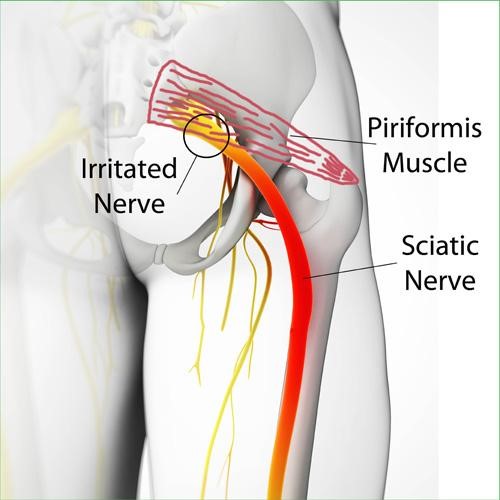
Piriformis syndrome results from compression of the sciatic nerve as it passes underneath a muscle in your buttock called the piriformis. Your piriformis muscle attaches from the lowest part of your spine (sacrum) and travels across to your hip. The muscle helps to rotate your leg outward when it contracts. In most people, the sciatic nerve travels deep to the piriformis muscle. When your piriformis muscle is irritated or goes into spasm, it may cause a painful compression of your sciatic nerve. Approximately ¼ of the population is more likely to suffer from piriformis syndrome because their sciatic nerve passes through the muscle.
Piriformis syndrome may begin suddenly because of an injury or may develop slowly from repeated irritation. Common causes include a fall onto the buttocks, hip abductor weakness, catching oneself from a “near fall,” strains, long-distance walking, stair climbing, or sitting on the edge of a hard surface or wallet. Most times, a specific triggering event cannot be pinpointed. The condition is most common in 40 to 60-year-olds and affects women more often than men.
Symptoms of piriformis syndrome include pain, numbness, or tingling that begins in your buttock and radiates along the course of your sciatic nerve toward your foot. Symptoms often increase when you are sitting or standing in one position for longer than 15-20 minutes. Changing positions may help. You may notice that your symptoms increase when you walk, run, climb stairs, ride in a car, sit cross-legged, or get up from a chair.
Sciatica arising from piriformis syndrome is one of the most treatable varieties and often is relieved by the type of treatment provided in this office.
Image on this page provided by ChiroUp.
Your Path to Wellness Begins Here!
Our experts in chiropractic, physical therapy, acupuncture, and massage therapy work as a team to provide holistic care that meets your specific needs. Book your appointment today and experience coordinated care.