


Rib Subluxation: What It Is, What It Feels Like, and How It Gets Fixed
Sharp pain when you take a deep breath. Pain that wraps around your chest or radiates toward your breastbone. A stabbing sensation when you twist, reach overhead, or sneeze. Sometimes a visible bump or a sensation that something is “out of place” along your ribcage.
And then you get a chest X-ray and it comes back normal.
This is one of the more confusing and underdiagnosed presentations we see. Rib subluxation doesn’t show up on most imaging because the rib isn’t broken or fully dislocated — it’s moved subtly at one of the small joints where it connects to the spine. Enough to lock up, cause significant pain, and make breathing feel like work. Not enough to appear on a standard X-ray.
Here’s what’s actually happening, why it gets missed so often, and how it gets fixed.
What a rib subluxation actually is
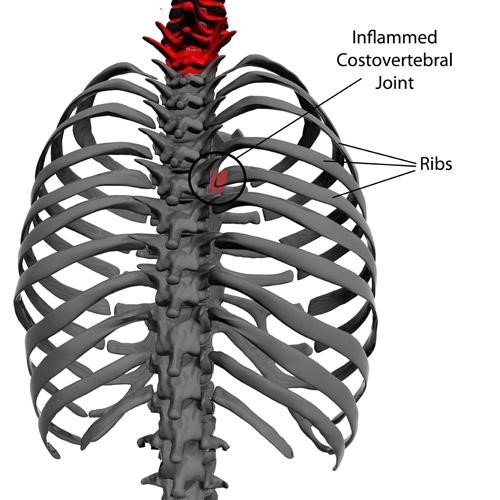
Your rib cage consists of 12 pairs of ribs. Most of them attach to your spine at the back through two small joints: the costovertebral joint (where the rib head meets the vertebral body) and the costotransverse joint (where the rib neck meets the transverse process of the vertebra). At the front, ribs 1–10 connect to the sternum through cartilage. Ribs 11 and 12 — the “floating ribs” — don’t connect to the sternum at all.
A subluxation means a joint has lost its normal alignment or mobility without fully dislocating. In the rib cage, this typically happens at the costovertebral or costotransverse joint — the rib shifts slightly, the surrounding muscles go into protective spasm, and the joint loses its normal gliding motion.
The result is a joint that’s stuck rather than broken. That’s why X-rays are usually unremarkable. The bone is still there and structurally intact. What’s changed is the mechanics of the joint — and that’s a clinical finding, not an imaging finding. A trained examiner can detect it through palpation and motion testing. An X-ray cannot.
This is also why rib subluxation frequently gets misdiagnosed. Depending on where the subluxated rib is and how the pain radiates, it gets labeled costochondritis, pleurisy, intercostal neuralgia, musculoskeletal chest pain, or simply “we don’t see anything on imaging.” Patients often leave without a clear explanation for pain that is, in fact, very explainable.
What it feels like — and what makes it confusing
The symptoms vary depending on which rib is affected and whether the subluxation is at the posterior (spinal) or anterior (sternal) end. Common presentations include:
- Sharp, localized pain along the rib line — often described as a stabbing or catching sensation
- Pain that worsens with deep breathing, coughing, sneezing, or laughing
- Pain with twisting or lateral bending — reaching across your body, getting in and out of a car, rolling over in bed
- A “stitch” sensation in the side during or after exercise that doesn’t resolve the way a typical stitch does
- Referred pain that wraps around the chest toward the sternum or into the upper abdomen — this is where the cardiac and GI misdiagnosis comes from
- A tender spot you can locate precisely with your finger — usually along the rib, near the spine, or at the costochondral junction
- A popping or clicking sensation with movement, sometimes accompanied by a visible shift in the rib
- Upper back tightness or muscular spasm around the affected area — the paraspinal muscles and intercostals guarding the subluxated joint
Where it tends to mimic other conditions
Mid and upper rib subluxations (ribs 4–8) can produce chest pain that feels cardiac, particularly when it radiates anteriorly. Patients who’ve been evaluated for cardiac causes and found clear sometimes end up here — which is the right next step, but not the typical first thought.
Lower rib subluxations (ribs 8–12) can produce pain that mimics gallbladder, kidney, or abdominal issues — particularly slipping rib syndrome, where the lower floating ribs become hypermobile and irritate nearby nerves. This one is notoriously under-recognized in emergency and primary care settings.
Upper rib subluxations (ribs 1–3) can contribute to thoracic outlet-like symptoms — pain, tingling, or numbness into the arm and hand — because of the proximity to the brachial plexus and subclavian vasculature.
The common thread: the symptoms travel, the imaging is unremarkable, and the diagnosis requires a hands-on examination.
What causes it
Rib subluxations happen from both sudden events and cumulative strain. The most common causes we see:
A single mechanical event. An awkward twist, a fall, a coughing or sneezing fit, a heavy lift with a rotational component, or any sudden movement that loads one side of the thoracic cage asymmetrically. Patients often know exactly when it happened — there’s a sharp onset during a specific moment they can describe precisely.
Repetitive strain. Rotational sports (golf, tennis, baseball, rowing), overhead work, and occupations that involve sustained unilateral loading can stress the costovertebral joints over time. The subluxation may develop gradually rather than acutely.
Pregnancy and postpartum. Ligamentous laxity during pregnancy, combined with rib flare from a growing uterus, makes costovertebral and costotransverse joints more vulnerable. Postpartum rib pain — often from nursing positions, carrying, or the delivery itself — is common and underaddressed.
Thoracic hypomobility. When thoracic spine mobility is restricted — which is common in people who sit for long periods, have forward head posture, or have had thoracic injuries — the ribs that attach to those vertebrae are also restricted. Restricted motion at the thoracic spine means the rib joints are moving abnormally with every breath and every rotation. Over time this creates joint irritation and, eventually, subluxation.
Trauma. Motor vehicle accidents, contact sports injuries, and falls can subluxate ribs directly or produce thoracic spine dysfunction that secondarily affects rib mobility.
Why it keeps coming back — and what that means
Rib subluxations that recur are usually telling you something about the underlying thoracic mechanics, not just the rib itself.
If a rib subluxates once from a clear acute event — a heavy sneeze, an awkward twist — and resolves with treatment and doesn’t return, the story ends there. But patients who have the same rib “going out” repeatedly, or who have multiple ribs affected over time, have a thoracic mobility problem driving the pattern.
Thoracic hypomobility is the most common underlying driver. When the thoracic spine lacks normal segmental mobility, the ribs at those levels are forced into abnormal motion with every breath cycle — thousands of repetitions per day. The costovertebral joints absorb that abnormal stress until one of them gives.
Addressing the rib subluxation without addressing the thoracic restriction it’s coming from produces short-term relief that doesn’t hold. The rib gets adjusted; it feels better; a few weeks or months later it’s back. This is the recurrent presentation that leads patients to say “I just keep going out” — and it’s not a mystery, it’s mechanics.
The other common driver is a postural pattern — specifically, a thoracic kyphosis combined with forward head posture — that loads the posterior rib joints chronically. In those patients, the rib adjustment is still correct, but without addressing the postural loading pattern, the relief will be temporary.
How it’s diagnosed
Rib subluxation is a clinical diagnosis. The key findings on examination:
Motion palpation — the affected rib head will either be restricted or hypermobile compared to adjacent levels. A trained examiner can feel the difference in joint play with passive motion testing.
End-feel assessment — the costovertebral joint should have a specific end-feel with passive motion. A subluxated joint typically has an altered end-feel — either blocked or excessively lax.
Tenderness on palpation — there will usually be a precise, localized tender point over the rib head posteriorly or over the costochondral junction anteriorly. This localization is specific in a way that helps distinguish rib subluxation from thoracic disc pain, which tends to be more diffuse.
Breathing assessment — observation and palpation of respiratory mechanics can identify asymmetry in rib excursion, where one rib or a section of the rib cage isn’t expanding symmetrically with inhalation.
Symptom reproduction — specific positioning or provocation tests that load the costovertebral joint will reproduce the patient’s familiar pain pattern.
Imaging is indicated when there’s a concern about fracture (particularly in older patients with osteoporosis, or after significant trauma), tumor, or other structural pathology that needs to be ruled out before proceeding with manipulation. In straightforward presentations without red flags, it adds little to the clinical picture and the decision to treat.
How it’s treated
Rib subluxations respond well to conservative care and typically resolve in a small number of visits when properly diagnosed and treated. The approach at Ashworth Clinic includes:
Chiropractic adjustment of the affected costovertebral/costotransverse joints. This is the primary intervention. The adjustment restores normal joint alignment and mobility. Depending on the rib and the patient’s presentation, this may be done in prone, seated, or side-lying positioning. The technique is specific to the rib joint rather than a general thoracic adjustment. Most patients notice immediate improvement in the catching sensation with breathing following the first treatment.
Thoracic spine mobilization. Because the thoracic restriction is often part of what drove the subluxation, addressing segmental mobility at the involved thoracic levels is part of the same treatment — not an add-on. If T5 is restricted and the 5th rib subluxated, treating the rib without addressing T5 is an incomplete approach.
Soft tissue work. The intercostal muscles, paraspinal muscles, and serratus anterior often need direct treatment — they’re in spasm around the affected joint and will continue to load it abnormally if left alone. This may include trigger point work, myofascial release, or instrument-assisted soft tissue mobilization.
Breathing mechanics. For patients with altered respiratory patterns — particularly those who’ve been guarding against deep inhalation for days or weeks — reestablishing full rib excursion with breathing is part of recovery. Restricting your own breathing to avoid pain produces secondary muscle guarding and thoracic stiffness that compounds the problem.
Postural correction. In patients with a thoracic kyphosis pattern or forward head posture driving recurrent subluxations, specific postural work is part of the plan. This may include targeted exercises and correction of workstation or sleep position.
When to get evaluated — and what warrants immediate attention
Most rib subluxations are mechanical, benign, and straightforward. But chest pain always warrants appropriate triage. Get evaluated immediately if you have:
- Chest pain accompanied by shortness of breath, arm pain, jaw pain, or sweating — rule out cardiac cause first
- Fever with chest pain — could indicate pneumonia, pericarditis, or pleuritis
- History of cancer with new onset rib pain — warrants imaging before treatment
- Chest pain after significant trauma — rule out rib fracture before manipulation
If you’ve already ruled those out, or if the pain is clearly mechanical in nature (worse with movement and palpation, better with rest, reproduced by pressure on the rib), you’re dealing with a musculoskeletal problem and conservative care is the appropriate starting point.
How we approach this at Ashworth Clinic
Rib subluxation is one of the more satisfying presentations in clinical practice — it’s a problem with a clear mechanical explanation, a specific diagnosis you can confirm on examination, and a treatment that works quickly when the diagnosis is right.
We see it regularly — in athletes with rotational loading, in patients postpartum, in people who sneezed wrong, and in patients who’ve had months of thoracic tightness that finally expressed as a rib going out. The evaluation includes motion palpation of the rib cage and thoracic spine, assessment of breathing mechanics, and a clinical determination of whether the rib, the thoracic joint, or the surrounding soft tissue is the primary driver.
Most patients with a straightforward rib subluxation resolve in 3–5 visits. If it keeps coming back, we look harder at the underlying thoracic mechanics or postural drivers — because recurrence usually means we haven’t addressed the cause, only the symptom.
You can reach us at (515) 225-4002 or request an appointment online. If you’ve had chest pain that’s already been cardiac-cleared and you’re looking for a mechanical explanation, this is often it.
Frequently asked questions
What does a rib subluxation feel like?
Sharp pain when breathing deeply, twisting, sneezing, or coughing is the most common presentation. The pain is usually well-localized — patients can often point to exactly where it hurts, often along the rib line or near the spine. Some people feel a catching sensation or a pop. The pain may radiate around the chest toward the sternum or into the upper abdomen, which is why rib subluxation frequently gets confused with cardiac, gastrointestinal, or pulmonary conditions.
Can ribs go out of alignment without injury?
Yes. Many rib subluxations develop from cumulative mechanical stress rather than a single traumatic event — repetitive rotation, prolonged thoracic stiffness, or the sustained rib flare of pregnancy. Patients are sometimes surprised to have significant rib pain without any clear incident they can point to.
Will a rib subluxation show up on an X-ray?
Usually not. A subluxation is a joint mechanics problem, not a structural fracture. The rib is still where it’s supposed to be — it’s just not moving correctly. X-rays show bone position and integrity well; they don’t show joint mobility. This is why many patients with rib subluxations are told their imaging is “normal” despite significant pain. The diagnosis is clinical, confirmed by palpation and motion testing.
How long does a rib subluxation take to heal?
Most straightforward cases resolve in 3–5 chiropractic visits over 2–4 weeks. First-visit improvement in breathing comfort is common after the adjustment. Cases that have been present longer, or that involve significant soft tissue guarding and thoracic restriction, may take longer — but rarely approach the timelines people expect from their experience with back pain.
Can a rib subluxation heal on its own?
Some mild cases improve with rest and time, particularly if the joint returns to normal alignment spontaneously. However, rib subluxations that don’t resolve on their own tend to develop increasing soft tissue guarding around the joint, which makes the problem more persistent. A joint that’s been locked for weeks is harder to treat than one addressed early. If symptoms aren’t improving in a week with rest, evaluation makes sense.
Can I self-adjust a subluxated rib?
This is not recommended. The costovertebral joints are specific and require precise directional force to restore normal mechanics. Self-manipulation usually produces a general cavitation (pop) rather than a specific adjustment to the affected joint. It may feel temporarily satisfying but doesn’t reliably address the subluxation, and improper force to the thoracic cage carries real risk.
Can the front of my rib cage, near the sternum, be affected too?
Yes. Rib subluxation isn’t limited to where the ribs attach to the spine — the same mechanical dysfunction can occur at the front, where the ribs meet the sternum through cartilage (the costosternal joints), sometimes called sternum subluxation. The presentation and treatment approach are essentially the same as costovertebral rib subluxation, just localized to the front of the chest rather than the back.
Written by Matthew Wilson, DC — Ashworth Chiropractic, Physical Therapy and Acupuncture, West Des Moines, IA
Coordinated Care, Under One Roof
Chiropractic care, physical therapy, acupuncture, massage, shockwave therapy, and functional medicine are coordinated under one roof, so a patient who needs more than one discipline is not left to manage care between separate offices. Each provider works from the same diagnosis, in the right sequence, toward the same goal: getting you better.