
SI Joint Pain: Why It Keeps Getting Missed — And What Actually Fixes It
If you’ve been told your MRI is normal but your low back, hip, or glute still hurts every time you stand up from a chair, sit too long, or roll over in bed — there’s a decent chance nobody has actually looked at your SI joint. Not tested it directly. Not ruled it in or out. Just glanced at an image of your spine, called it clean, and moved on.
That’s not a knock on the provider. The sacroiliac joint is one of the most commonly missed sources of low back and buttock pain in medicine — not because it’s rare, but because it’s genuinely hard to find if you’re not looking for it specifically. It’s also the single most common condition we see walk through our doors. Of the 4,443 outcome reports in our system, 543 are SI joint cases — more than any other condition we treat, by a wide margin.
A study published this year gives some hard numbers to back up what that volume has taught us. Here’s what it found, what it doesn’t prove, and what we actually do differently once we’ve confirmed the SI joint is the real source of the problem.
What a New Study Found About SI Joint Manipulation
A cohort study published in June 2026 in Neurologia i Neurochirurgia Polska followed 100 adults with low back and radicular leg pain attributed to sacroiliac joint dysfunction through a standardized manipulation protocol at a single center. The results were dramatic: median pain scores on a 0–10 scale dropped from 8 at baseline to 1 after the very first treatment session, and to 0 by the end of the series — improvement that held at the 3-month follow-up. Disability scores (Oswestry Disability Index) fell from 30 to 7 over the same period.
We’re not going to oversell this. It’s a good result, but it’s one center, 100 patients, no control group, and no blinding — the authors themselves say it needs a randomized, blinded trial before anyone treats it as proof. A patient who improves after a manipulation might have improved on their own timeline anyway, and an uncontrolled cohort can’t rule that out. If a study showed weak results, we’d tell you that too — that’s the whole point of not cherry-picking research to fit a sales pitch.
What we can say is that this isn’t an outlier. It lines up with what shows up in our own numbers, independently, across a much longer track record.
Why This Matches What We See Here
SI joint dysfunction isn’t a condition we occasionally treat — it’s the largest single category in our outcomes data, ahead of upper cross syndrome, thoracic restriction, and every other condition we track. Across all 4,443 patient reports in our system — 120+ conditions, SI joint included — the clinic-wide average is 80.8% improvement in 6.3 visits.
The SI joint number specifically is better than that average, not just consistent with it: 543 SI joint cases tracked, 84% average improvement, in an average of 5 visits. For comparison, the ChiroUp national benchmark for this same condition — the pooled average across chiropractic offices using the same outcomes-tracking platform — is 79% improvement in 7 visits. We’re beating the national number on both improvement and speed, on our highest-volume condition, not a handful of easy cases.
That’s not a coincidence, and it’s not us cherry-picking a good month. It’s what happens when a condition gets a real diagnostic process instead of a guess.
Why SI Joint Pain Gets Missed So Often
Your MRI can be genuinely normal — and your SI joint can still be the problem
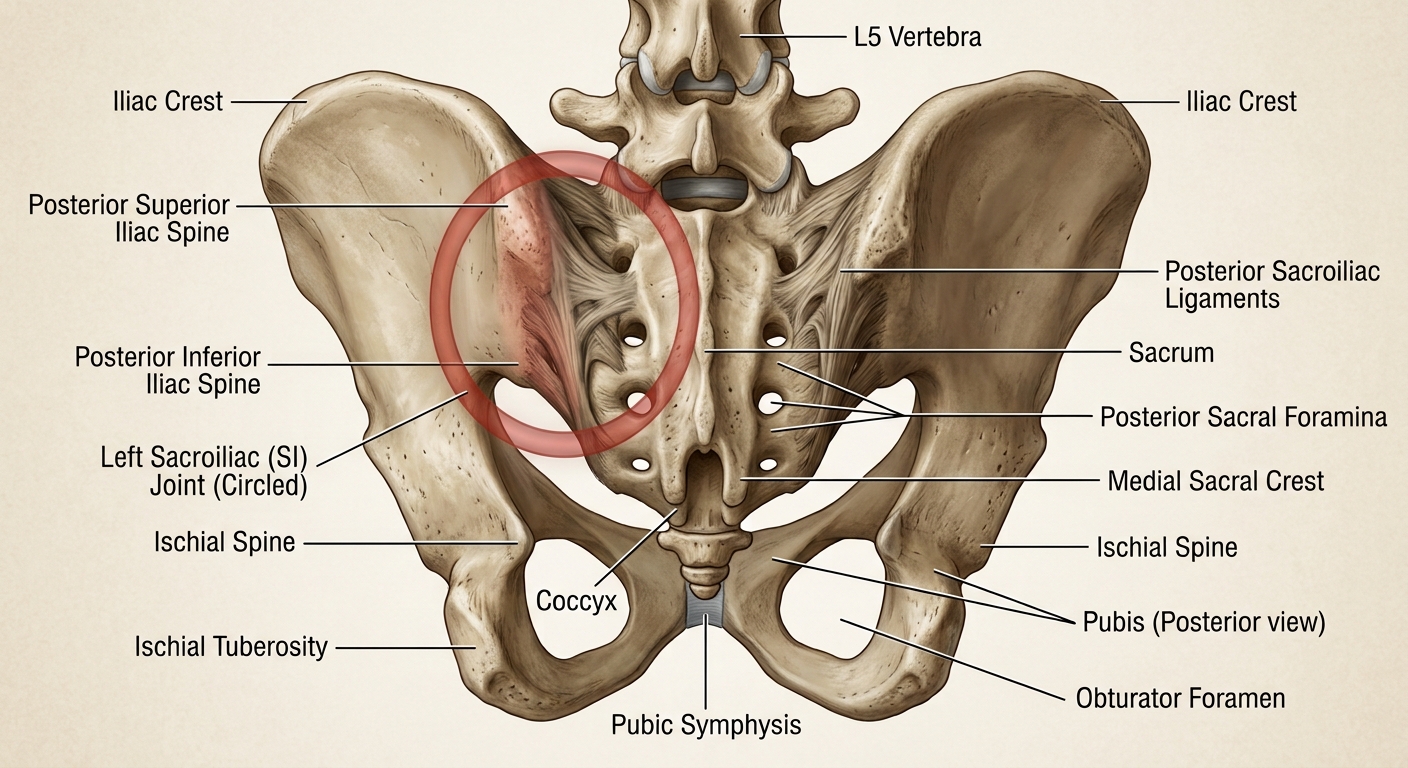
The SI joint is buried deep in the pelvis, sits at an angle that’s difficult to image cleanly, and doesn’t show the kind of clear structural findings — disc bulges, stenosis, obvious degeneration — that jump off a standard MRI report. A patient can have real, mechanically-driven SI joint dysfunction and a radiology report that says everything looks fine. That’s not a contradiction. It’s a limitation of what static imaging is built to detect. Imaging is excellent at ruling out fracture, tumor, and serious spinal pathology. It’s a poor tool for diagnosing a joint dysfunction that’s fundamentally about how the joint moves and loads, not what it looks like sitting still.
It mimics other things
SI joint pain refers into the low back, the buttock, sometimes down the back of the leg — territory that overlaps heavily with disc-related low back pain, piriformis syndrome and sciatica, and hip pathology. A patient can spend months getting treated for one of those and never improve, not because the treatment was wrong in general, but because it was aimed at the wrong structure entirely.
The standard exam often stops at a couple of provocation tests
Most SI joint exams rely on a handful of pain-provocation maneuvers — pressure applied in specific positions to see if it reproduces the pain. Individually, those tests have modest accuracy. Used in isolation, one or two of them aren’t enough to confirm or rule out the joint with any real confidence. That’s part of why the diagnosis gets missed or gets made incorrectly in both directions.
Who Ends Up With This
A few patterns show up often enough in our own case volume that they’re worth naming directly. Runners and other single-plane, repetitive-motion athletes, because the SI joint takes asymmetric load with every stride. Pregnant and postpartum patients, because hormonal changes loosen the ligaments that normally stabilize the joint — this is common enough that we treat it as its own category, not a footnote. Anyone who spends most of the day sitting, especially with a habitual leg-cross or weight-shift, because that position loads one side of the pelvis more than the other for hours at a stretch. And anyone recovering from a hip or low back injury on one side, because the body compensates through the pelvis whether you notice it happening or not.
None of that means you diagnose yourself from a list. It means if you fit one of these patterns and you’ve been told your imaging is clean, it’s worth having the joint tested directly instead of assumed clear by association.
When to Skip Manipulation and Get Imaging First
Honest triage means naming the exceptions, not just the philosophy. A handful of signs mean the right first step is imaging or a same-day referral, not a course of manual treatment: fever alongside the pain, unexplained weight loss, pain that wakes you from sleep and isn’t positional, new bowel or bladder changes, or a history of cancer, recent significant trauma, or IV drug use. Those aren’t SI joint red flags specifically — they’re red flags for anything in the low back and pelvis — but they matter here because SI joint pain and serious pathology can present in overlapping territory. If any of that applies to you, say so before your first visit. It changes what we do first.
The Exam We Actually Run
This is where our intake looks different than a standard chiropractic evaluation. Every new patient goes through a PRI-based functional exam — an assessment framework built around a fact most providers don’t factor into their exams at all: the human body isn’t bilaterally symmetrical. Your liver sits on the right. Your heart tilts left. Your diaphragm moves differently side to side. Over time, that built-in asymmetry produces compensation patterns in how you stand, breathe, and move — patterns that can load one SI joint chronically more than the other, long before pain shows up anywhere near the pelvis.
Instead of asking only “where does it hurt,” the PRI-based exam asks why the pelvis is holding the position it’s holding — looking at breathing mechanics, stance, and how the whole system is organized, not just the joint itself. That’s usually the first time a patient who’s been through months of care elsewhere gets a straight answer for why nothing else worked: not because the previous treatment was bad, but because it was treating a symptom pattern without ever identifying what was actually driving it.
What Treatment Actually Looks Like
Once we’ve confirmed the SI joint is genuinely the source — not assumed it, confirmed it — treatment follows the same hierarchy we use for everything: least invasive, quickest realistic path to resolution, least expensive, in that order. For most SI joint cases, that means manual and instrument-based adjusting matched to what the exam found, not a fixed protocol applied the same way to every patient. Dr. Wilson is Palmer-trained for precise manual adjusting, but also carries a wider toolbox — instrument adjusting, SOT, Thompson Drop Table, Cox Flexion-Distraction — because the right technique depends on the diagnosis, not on which one a provider defaults to.
There’s no pre-set visit package. We don’t sell a bundle of sessions before we know how you’ll respond. You’re reevaluated as you go, and when you’re better, you’re discharged — that’s the goal, not a threat to your care plan. If you’re not responding the way we’d expect, we say so directly, and we escalate or refer out rather than keep running the same approach hoping it eventually works. Full pricing and how visits are billed (no contracts, pay for what you get) is on our cost of care page.
When It’s Not Your SI Joint
Honest triage cuts both ways. Not every case of low back or buttock pain that looks like SI joint dysfunction actually is. Sometimes the real driver is a disc issue, sometimes it’s piriformis syndrome or a hip problem wearing the same symptom pattern, and sometimes it’s a combination that needs to be sequenced rather than treated as one thing. Part of what the functional exam is for is telling the difference — and telling you plainly if what you have isn’t something we think we’re the right fit to fix. That’s true even when it would be easier, short-term, to just start treating and see what happens.
Common Questions
What does SI joint pain actually feel like? Usually a deep ache on one side of the low back or buttock, sometimes radiating into the back of the thigh (rarely past the knee). It’s commonly worse with prolonged sitting, standing up from a seated position, or shifting weight onto the affected side — activities that load the joint asymmetrically.
Why does chiropractic or manipulation help if the joint isn’t “out of place”? The SI joint has very limited natural motion — a few millimeters, not the large range people sometimes picture. Manipulation addresses restricted motion and the surrounding muscular guarding, not a bone that’s literally displaced.
How many visits does it typically take? Across the 543 SI joint cases in our outcomes data, the average is 5 visits, with 84% average improvement — fewer visits and a better result than the 7-visit, 79%-improvement national benchmark for this condition. That’s an average, not a promise, and some cases take longer. Most patients know within the first few visits whether the approach is working for them.
Can SI joint pain come back? It can, especially if the underlying compensation pattern that loaded the joint in the first place was never addressed — which is exactly why the exam looks upstream of the joint itself, not just at it.