


Weak Hip Adductors: Signs, Causes, and What to Do About It
If you’ve ever felt your hip give a little when you plant and cut, or noticed a dull ache along the inside of your thigh after a long run, or found yourself bracing your knees together just to feel stable standing on one leg — there’s a reasonable chance your hip adductors aren’t doing their job.
Most people have heard of hip abductor weakness. It gets talked about because it shows up clearly — a hip that drops, a knee that caves in on a squat. The adductors, on the inside of the thigh, get a lot less attention. But they’re doing just as much work, in the opposite direction, and when they’re not pulling their weight, the pattern that develops is different — and in some patients, it involves a system most providers never think to check: the pelvic floor.
What the Hip Adductors Actually Do
The adductor group — adductor longus, adductor brevis, adductor magnus, gracilis, and pectineus — runs along the inside of the thigh from the pelvis to the femur and, in some cases, down to the knee. Their obvious job is pulling the leg back toward the midline. Their less obvious job, and the one that matters most day to day, is controlling how far the leg is allowed to drift away from the midline during single-leg loading — walking, running, stairs, lateral movement in sport.
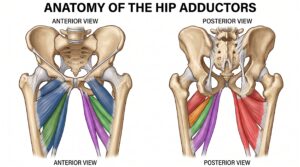
Where the abductors resist the pelvis dropping to the outside, the adductors resist the leg swinging too far out and the pelvis losing control to the inside. It’s the same stabilization job as the abductors, worked from the opposite side of the joint. When one side of that pairing is weak, the other side usually ends up overworking to compensate — which is part of why adductor and abductor problems so often show up together rather than in isolation.
Inhibition or Weakness — the Same Distinction That Matters for the Abductors
Just like we cover on the hip abductor weakness page, “weak” isn’t always the right word. There’s a real difference between a muscle that’s genuinely under-conditioned and a muscle that’s neurologically inhibited — turned down by the nervous system because of a joint restriction, an active trigger point, or a movement pattern the body has learned to avoid.
The distinction matters clinically because the fix is different. True weakness responds to progressive loading — you strengthen it, and it gets stronger. Inhibition doesn’t respond to loading the same way, because the muscle isn’t actually incapable — it’s being told not to fire fully. Load an inhibited muscle without addressing what’s inhibiting it, and progress stalls, or the compensating muscles just get louder. Clearing the restriction or trigger point first, then loading, is what actually moves the needle in that case.
This is one of the most common reasons a home exercise program for “weak adductors” doesn’t work as well as expected — the exercises are right, but the muscle wasn’t actually weak in the way it looked.
The Connection Most Providers Miss: Adductors and the Pelvic Floor
This is the part of adductor dysfunction that doesn’t get discussed nearly enough, and it’s specific to the adductors — the abductors don’t share this relationship in the same way.
The obturator internus, a deep hip rotator that works closely with the adductor group, shares a direct fascial connection with the levator ani — the primary muscle group of the pelvic floor. A 2023 cadaver study published in the Journal of Anatomy mapped this connection directly, finding broad, continuous contact between the obturator internus and levator ani through the obturator fascia, with the obturator fascia serving as an attachment point for multiple layers of the pelvic floor. Separately, a study in PLOS One measured this relationship functionally in living patients, finding that hip adduction and abduction contractions measurably changed pelvic floor muscle force output — which is part of why pelvic floor physical therapists frequently combine adductor work with classic pelvic floor exercises in the first place.
Postural Restoration Institute’s own clinical materials describe the same relationship from a different angle: adductor activation requires co-contraction from the pelvic floor — the levator ani group, the obturators, and the coccygeus — working together, not independently.
What that means practically: a patient with adductor weakness or inhibition, particularly postpartum patients or patients with a history of pelvic floor dysfunction, may have a groin or inner-thigh presentation that’s actually tangled up with pelvic floor function — and a program that only addresses the adductor in isolation may miss the actual driver.
This is exactly the kind of case where having a Women’s Health Certified Specialist on staff changes what’s possible. Kelly Brown Gross, PT, WCS, is one of only about five WCS-certified physical therapists in Iowa and the only one in the Des Moines metro. When an adductor presentation has a pelvic floor component — which is more common than most patients expect, especially postpartum — that’s not a guess Kelly has to make from a textbook. It’s a connection she can evaluate directly.
To be clear about the limits here: not every case of adductor weakness involves the pelvic floor, and we’re not going to tell every patient with a sore inner thigh that their pelvic floor is the problem. Most groin tightness after a hard week of pickleball is exactly what it looks like. But when the presentation includes postpartum history, pelvic floor symptoms, or an adductor problem that isn’t responding to a straightforward loading program, this is the connection worth ruling in or out — rather than never being asked about at all.
Signs of Weak or Inhibited Adductors
- A feeling of instability or “looseness” in the hip during lateral movement — cutting, skating motions, side-stepping
- Groin or inner-thigh ache that develops during or after activity, without a clear acute injury
- Tenderness with resisted adduction — squeezing the knees together against resistance reproduces the ache
- A tendency to widen your stance more than feels natural, or to avoid single-leg loading altogether
- Recurrent groin strains, particularly in sports involving quick direction changes (soccer, hockey, pickleball, tennis)
- In postpartum patients: groin or pelvic-region symptoms that showed up or worsened after delivery
What Causes Adductor Weakness or Inhibition
- Postpartum changes. Pregnancy alters pelvic alignment, stretches and loads the pelvic floor differently, and changes how weight moves through the hips. Adductor and pelvic floor symptoms showing up together postpartum is common — not a coincidence.
- Prior groin strain or “sports hernia.” An adductor strain that healed structurally can still leave behind inhibition and a movement pattern the body avoids loading fully.
- Prolonged sitting and asymmetric loading. The body doesn’t hold itself perfectly symmetrically at rest, and habitual position — how you sit, stand, and carry weight day to day — shapes which side ends up doing more of the stabilizing work over time.
- Compensation for abductor weakness, or vice versa. Because these two muscle groups stabilize the same joint from opposite sides, a problem in one frequently shows up as overcompensation, and eventual fatigue or inhibition, in the other.
What We Do About It
The starting point is the same as it is for every presentation in this clinic: figure out what’s actually going on before treating anything. That means distinguishing true weakness from inhibition, checking whether there’s a pelvic floor component worth involving Kelly in, and ruling out that the “adductor problem” isn’t actually being driven by something upstream — a restriction at the hip, SI joint, or pelvis.
From there:
- If it’s true weakness, progressive adductor loading — squeeze-based exercises, side-lying adduction work, lateral movement retraining — done consistently, with a program that respects tissue tolerance rather than jumping to end-range too fast.
- If it’s inhibition, we address the restriction or trigger point driving it first. Loading an inhibited muscle without doing this tends to just reinforce the compensation pattern.
- If there’s a pelvic floor component, Kelly evaluates that piece directly rather than the adductor being treated in isolation while the actual driver goes unaddressed.
- If there’s an underlying asymmetry pattern contributing to the presentation, that’s assessed as part of the broader picture — not every adductor case needs this level of analysis, but for the patients where it’s relevant, it’s part of what a thorough evaluation here looks like.
When to Get This Looked At
Home exercises are a reasonable starting point for mild, recent-onset symptoms. A clinical evaluation is worth scheduling if:
- Symptoms haven’t meaningfully improved after several weeks of consistent home exercise
- There’s clear side-to-side asymmetry in strength or comfort
- You’re postpartum and noticing groin or pelvic symptoms together
- You have a history of recurrent groin strains that keep coming back
- Pain is sharp, localized, or worsening rather than a dull, activity-related ache
Frequently Asked Questions
Can weak adductors cause groin pain? Yes. Adductor weakness and inhibition are common contributors to chronic groin and inner-thigh discomfort, particularly in patients with a history of groin strain or recurrent overuse in sports involving lateral movement.
Are hip adductors really connected to the pelvic floor? Anatomically, yes — the obturator internus, a deep hip muscle that works closely with the adductor group, shares a direct fascial connection with the levator ani, the primary pelvic floor muscle. This connection has been documented in cadaver studies and measured functionally in living patients. It doesn’t mean every adductor issue involves the pelvic floor, but it’s a real relationship worth considering, especially postpartum.
How do I know if it’s weakness or something else? A resisted strength test performed clinically is the most reliable way to tell true weakness from inhibition. As a rough home indicator: if targeted strengthening exercises haven’t produced any improvement after several consistent weeks, inhibition is more likely than simple deconditioning.
Do I need pelvic floor PT for this? Not necessarily. Most adductor weakness doesn’t require it. But if you’re postpartum, have known pelvic floor symptoms, or your adductor symptoms aren’t responding to a standard strengthening approach, it’s worth having that piece evaluated rather than ruled out by default.