


Shockwave Therapy for Greater Trochanteric Bursitis: What the Research Shows and What to Expect
By Dr. Matthew Wilson, DC, FIACA | Ashworth Chiropractic, Physical Therapy & Acupuncture | West Des Moines, Iowa
Greater trochanteric bursitis is one of the most common causes of chronic outer hip pain we see — and one of the most misunderstood. If you’re dealing with an ache along the outside of your hip that gets worse lying on that side at night, or that flares after walking or climbing stairs, you already know how disruptive it is.
Most people try the standard path first: rest, NSAIDs, physical therapy, maybe a cortisone injection. For some, that’s enough. But for a large share of patients, the pain keeps coming back, or the relief from an injection fades in a matter of weeks.
That’s where shockwave therapy comes in — and the research behind it for this condition has grown substantially in the last several years.
What Is Greater Trochanteric Bursitis and Why Does It Become Chronic?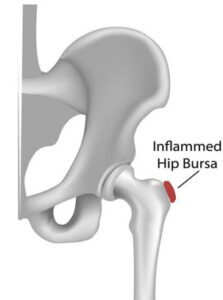
The trochanteric bursa is a small fluid-filled sac that sits over the bony prominence on the outside of your hip — the greater trochanter — cushioning the point where your gluteal tendons and the iliotibial band glide over the bone. When that area becomes irritated, the outer hip aches, often radiating down the outside of the thigh, and it’s usually tender to direct pressure.
Here’s the part most patients are never told: in chronic cases, imaging studies consistently find that the bursa itself is often not the primary problem. What’s actually driving most persistent lateral hip pain is tendinopathy of the gluteus medius and gluteus minimus tendons — the muscles that attach right at that same spot. This is common enough, and clinically significant enough, that the condition now has a broader name in the research literature: greater trochanteric pain syndrome (GTPS), which covers bursitis, gluteal tendinopathy, or both together.
We’re telling you this not to be pedantic, but because it changes what “treatment” actually needs to accomplish. A bursitis-only model suggests you just need to calm inflammation. A tendinopathy model means the tendon tissue itself needs to actually repair and remodel — which is a biological process, not just an inflammatory one. Chronic GTPS behaves far more like the second scenario, and that’s exactly the kind of problem shockwave therapy is built to address.
Greater trochanteric pain syndrome affects an estimated 17.6% of adults between the ages of 50 and 79, and disproportionately affects women. It is not a rare or minor condition — it’s one of the most common sources of chronic hip pain in that age group.
Shockwave Therapy for Greater Trochanteric Bursitis
Shockwave therapy works by delivering high-energy acoustic waves to a precise focal point in the damaged tissue. For GTPS, the applicator is positioned directly over the greater trochanter, targeting the gluteal tendon insertions and the surrounding bursa and soft tissue.
The biological effects that make this useful in a chronic, degenerative condition like GTPS include:
- Stimulates neovascularization — the formation of new blood vessels — restoring blood flow to tendon tissue that has become degenerative and poorly supplied
- Triggers collagen production and tendon remodeling, replacing disorganized tissue with structurally sound repair
- Reduces substance P, a neuropeptide found at elevated levels in the trochanteric bursa of patients with GTPS and directly implicated in chronic pain signaling at that site
- Breaks down chronic scar tissue and calcific deposits that can form around the tendon insertion in long-standing cases
- Activates the tissue’s own repair response, rather than simply suppressing the pain signal
In plain terms: shockwave therapy doesn’t just quiet the ache over your hip.
It targets the tendon tissue itself, where the actual problem in most chronic cases lives.
What the Clinical Research Shows
The evidence base for ESWT in GTPS has matured considerably. Here’s what the peer-reviewed literature actually shows.
Systematic Review and Meta-Analysis — 754 Patients, 8 Randomized Controlled Trials
A 2024 systematic review and meta-analysis published in JBJS Reviews (Rhim et al.) pooled data from 8 randomized controlled trials covering 754 patients with GTPS. The review found that ESWT produced significantly lower pain scores than comparison treatments at 2 to 4 months, and significantly greater functional improvement (measured by the Lower Extremity Functional Scale) at 6 months. Focused ESWT — the type of device used at Ashworth — outperformed radial ESWT for pain reduction specifically. The authors’ conclusion: three weekly ESWT sessions provide meaningful short-term pain relief for GTPS, and the effect is strongest with focused shockwave technology.
Rhim HC, Shin J, Beling A, et al. JBJS Reviews. 2024;12(8). DOI: 10.2106/JBJS.RVW.24.00091.
Head-to-Head vs. Traditional Treatment
Multicenter Randomized Controlled Trial — 103 Patients
A 2020 multicenter trial published in the Journal of Bone and Joint Surgery (Ramon et al.) randomized 103 patients with chronic GTPS — diagnosed clinically and confirmed with ultrasound or MRI — to either focused electromagnetic ESWT plus a specific exercise protocol, or sham ESWT plus the same exercise protocol. Patients receiving genuine focused ESWT showed meaningfully better pain outcomes than the sham group, in a study designed specifically to rule out a placebo effect from the exercise component alone.
Ramon S, Russo S, Santoboni F, et al. J Bone Joint Surg Am. 2020;102(15):1305-1311. DOI: 10.2106/JBJS.20.00093.
ESWT vs. Ultrasound Therapy
A randomized controlled trial published in Clinical Rehabilitation (Carlisi et al.) compared focused ESWT directly against ultrasound therapy in 50 patients with GTPS and confirmed gluteal tendinopathy. ESWT produced significantly better pain reduction at both 2-month and 6-month follow-up than ultrasound therapy — a modality still commonly used in general physical therapy settings for this condition.
Carlisi E, Cecini M, Di Natali G, et al. Clin Rehabil. 2019;33(4):670-680. DOI: 10.1177/0269215518819255.
ESWT vs. Corticosteroid Injection
A randomized controlled trial published in Hip International (Heaver et al.) compared focused shockwave therapy directly against an ultrasound-guided corticosteroid injection — the treatment most patients are offered first for this condition. This head-to-head comparison is part of why ESWT is increasingly positioned as a legitimate alternative to injection, not just a fallback after injections stop working.
Heaver C, Pinches M, Kuiper JH, et al. Hip Int. 2023;33(3):490-499. DOI: 10.1177/11207000211060396.
CuraMedix / Storz Medical Clinical Data
CuraMedix, the U.S. distributor for Storz Medical — whose Duolith SD1 Ultra we use at Ashworth Chiropractic — reports an over 80% patient satisfaction rate across treated musculoskeletal conditions, consistent with what the peer-reviewed GTPS literature shows for pain and function outcomes.
★ What the research consistently shows across GTPS studies:
- Significant reduction in lateral hip pain, including pain that disrupts side-lying sleep
- Improved function in walking, stair climbing, and single-leg loading tasks
- Meaningful advantage over ultrasound therapy at both short- and medium-term follow-up
- A legitimate alternative to corticosteroid injection, not just a last resort after injections fail
- Best results with focused ESWT specifically, not radial devices
Why Shockwave Outperforms Cortisone Injections for Chronic Cases
Corticosteroid injections are the most commonly offered treatment for GTPS, and they can provide real short-term relief. The problem is what they don’t do: they don’t repair tendon tissue, and repeated injections into or around the gluteal tendons are associated with tendon weakening over time — a real risk in a condition where the tendon, not just the bursa, is usually the actual problem.
This is precisely the same trade-off we see with cortisone across other tendon conditions we treat with shockwave: temporary symptom relief without addressing the underlying tissue. For patients who’ve already had one injection with fading results, or who are hesitant to have another injection into the same tendon repeatedly, shockwave therapy targets the tissue itself rather than suppressing the pain signal around it.
What to Expect at Ashworth Chiropractic
We use the Storz Medical Duolith SD1 Ultra — true focused shockwave, not radial. That distinction is directly reflected in the research above: focused ESWT consistently outperformed radial ESWT for pain reduction in the GTPS literature, which is part of why we invested in a focused device rather than the radial machines more commonly found at other clinics.
Several of the strongest clinical trials for this condition — including the multicenter RCT above — used a three-weekly-session protocol. That’s a reasonable baseline expectation, but it’s not automatic. Here’s what your evaluation and treatment actually looks like:
- Initial evaluation to confirm the diagnosis, distinguish bursitis from gluteal tendinopathy where possible, and identify any biomechanical factors — hip abductor weakness, pelvic asymmetry, or gait pattern — contributing to the problem
- A session count determined by your specific presentation, not a preset package — we’ll walk you through what your case is likely to need before you commit to anything
- Each session is 5 to 15 minutes — no anesthesia, no downtime
- Shockwave is frequently paired with chiropractic or physical therapy to address the biomechanical drivers — hip and pelvic stability issues are common contributors to GTPS, and treating the tendon without addressing why it’s overloaded in the first place tends to produce shorter-lived results
That last point matters more for this condition than for some of the others we treat with shockwave. GTPS is strongly associated with hip abductor weakness and pelvic-level compensation patterns — the same territory covered in our hip abductor weakness article. When that’s part of the picture, we address it as part of the plan rather than treating the hip in isolation.
Common Questions About Shockwave for Greater Trochanteric Bursitis
Is this bursitis or something else?
Often something else, or both. Chronic lateral hip pain that gets labeled “bursitis” is frequently gluteal tendinopathy, and the two can occur together. We’ll assess which is driving your symptoms as part of your evaluation, because it affects the full treatment plan even though shockwave therapy is appropriate for either presentation.
How long do I need to have had this before shockwave is appropriate?
Shockwave therapy is most effective for chronic presentations — generally symptoms that have persisted for several months and haven’t fully resolved with rest, activity modification, and conservative physical therapy. If you’re early in the course of this, those more conservative steps should be tried first. We’ll discuss where you fall in that timeline at your evaluation.
Will my insurance cover shockwave therapy?
Most insurance carriers in the United States do not currently cover ESWT. We’re upfront about this. Pricing and session options are covered clearly at your evaluation, before you commit to anything.
What if I’ve already had a cortisone injection?
Prior injections don’t disqualify you. Patients who’ve had one or more injections with fading or incomplete relief are often good candidates for ESWT, since it addresses the tendon tissue itself rather than repeating the same short-term approach.
Can shockwave therapy be combined with physical therapy or chiropractic care?
Yes, and for this condition in particular, we frequently recommend it. Hip and pelvic stability issues are common drivers of GTPS. Addressing those alongside the tendon itself — rather than treating the hip in isolation — is part of what a thorough plan for this condition looks like here.
Learn More about Shockwave Therapy and the many conditions it can treat.
Clinical References
The following peer-reviewed studies were retrieved from PubMed and cited in this article. All DOIs link to the original published research.
- Rhim HC, Shin J, Beling A, Guo R, Pan X, Afunugo W, Ruiz J, Andrew MN, Kim J, Tenforde AS. Extracorporeal Shockwave Therapy for Greater Trochanteric Pain Syndrome: A Systematic Review with Meta-Analysis of Randomized Clinical Trials. JBJS Reviews. 2024;12(8). DOI: 10.2106/JBJS.RVW.24.00091
- Ramon S, Russo S, Santoboni F, Lucenteforte G, Di Luise C, de Unzurrunzaga R, Vetrano M, Albano M, Baldini R, Cugat R, Stella G, Balato G, Seijas R, Nusca SM, Servodidio V, Vulpiani MC. Focused Shockwave Treatment for Greater Trochanteric Pain Syndrome: A Multicenter, Randomized, Controlled Clinical Trial. J Bone Joint Surg Am. 2020;102(15):1305-1311. DOI: 10.2106/JBJS.20.00093
- Carlisi E, Cecini M, Di Natali G, Manzoni F, Tinelli C, Lisi C. Focused extracorporeal shock wave therapy for greater trochanteric pain syndrome with gluteal tendinopathy: a randomized controlled trial. Clin Rehabil. 2019;33(4):670-680. DOI: 10.1177/0269215518819255
- Heaver C, Pinches M, Kuiper JH, Thomas G, Lewthwaite S, Burston BJ, Banerjee RD. Greater trochanteric pain syndrome: focused shockwave therapy versus an ultrasound guided injection: a randomised control trial. Hip Int. 2023;33(3):490-499. DOI: 10.1177/11207000211060396
About the Author
Dr. Matthew Wilson, DC, FIACA, CCWP is the owner and lead clinician at Ashworth Chiropractic, Physical Therapy & Acupuncture in West Des Moines, Iowa. He is a Palmer College of Chiropractic honors graduate with advanced certifications in Graston Technique, Postural Restoration, functional medicine, acupuncture, laser therapy, and dry needling. He selected the Storz Medical Duolith SD1 Ultra for Ashworth Chiropractic after extensive evaluation of the shockwave market.