


Shockwave Therapy for Achilles Tendinopathy: Why Chronic Tendon Pain Stops Healing — and What Actually Fixes It
By Dr. Matthew Wilson, DC, FIACA | Ashworth Chiropractic, Physical Therapy & Acupuncture | West Des Moines, Iowa
Your Achilles tendon is the strongest tendon in your body. It bears forces several times your body weight with every step, every run, every jump. And when it gets hurt — and doesn’t fully get better — it has a way of quietly taking over your life.
You modify how you walk. You skip the workouts that used to be routine. You get up in the morning and take those first careful steps, waiting to see how bad it’s going to be today. You’ve probably tried rest, stretching, maybe a heel lift, maybe physical therapy. And it’s still there.
Here’s what’s likely going on — and why shockwave therapy is one of the few treatments that addresses it at the source.
What Is Achilles Tendinopathy — and Why Is It Different From a Strain?
A lot of people use the term “Achilles tendonitis” — the “-itis” suffix suggesting inflammation. And early in the injury, that’s accurate. But once Achilles pain has been present for more than a few weeks and hasn’t resolved, something different is usually happening.
The condition shifts from tendonitis — acute inflammation — to tendinopathy: a degenerative process where the tendon tissue itself begins to break down. Collagen fibers become disorganized. The tendon loses its normal structure. Blood flow to the area decreases. The tissue essentially stops repairing itself and enters a chronic state.
This is why rest alone doesn’t fix chronic Achilles pain. You’re not resting away inflammation — you’re waiting for tissue to heal that has largely given up trying to heal.
There are two distinct presentations worth knowing:
- Mid-portion Achilles tendinopathy — pain roughly 2 to 6 cm above the heel bone, often the most common presentation and typically associated with overuse or repetitive loading
- Insertional Achilles tendinopathy — pain right at the back of the heel where the tendon meets the bone, often more resistant to treatment and sometimes accompanied by bone spurs or calcifications
Both presentations respond to shockwave therapy, though the approach and expectations differ slightly between them.
The fundamental problem in chronic Achilles tendinopathy is not inflammation — it is tissue degeneration. Treatments that target inflammation (anti-inflammatories, cortisone) provide temporary relief at best. Treatments that stimulate biological repair address the actual problem.
How Shockwave Therapy for Achilles Tendinopathy Could Be the Right Medicine.
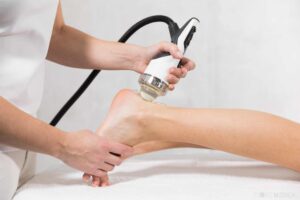
Shockwave Therapy for Achilles Tendinopathy
The Storz Medical Duolith SD1 Ultra delivers focused acoustic energy precisely to the degenerative tissue in the Achilles tendon. At that focal point, the shockwaves trigger a cascade of biological responses the tendon has stopped producing on its own:
- Stimulates neovascularization — the formation of new blood vessels — restoring circulation to tissue that has become ischemic and degenerative
- Triggers collagen synthesis and tendon remodeling, replacing disorganized degenerated tissue with properly structured repair
- Breaks down calcifications at the insertion site that are contributing to pain and restricted movement
- Reduces substance P — the primary pain-signaling neuropeptide in chronic tendon conditions
- Activates the body’s own stem cell recruitment and regenerative repair process
The critical distinction is this: shockwave therapy doesn’t suppress the pain signal. It restores the biological environment needed for the tendon to actually repair itself. That’s why the results tend to be durable in a way that cortisone injections and anti-inflammatories are not.
What the Clinical Research Shows
Based on articles retrieved from PubMed, here is what the peer-reviewed literature tells us about shockwave therapy for Achilles tendinopathy:
22 Studies — Mainly Beneficial Effects Reported
A comprehensive narrative review published in BioMed Research International (Stania et al.) reviewed 22 articles on ESWT for Achilles tendinopathy — the majority of which were randomized controlled trials. The review reported mainly beneficial effects of shockwave therapy across both focused and radial delivery modalities, and provided guidance on treatment parameters for clinical application. Both mid-portion and insertional Achilles tendinopathy were represented in the included studies.
Stania M, et al. Extracorporeal Shock Wave Therapy for Achilles Tendinopathy. Biomed Res Int. 2019;2019:3086910. DOI: https://doi.org/10.1155/2019/3086910
The Recurrence Advantage — Shockwave Keeps Results Longer
One of the most compelling findings in the Achilles literature comes from a double-blinded randomized controlled trial published in The Journal of Bone and Joint Surgery (Mansur et al., 2021) — one of the most prestigious orthopedic journals in the world. The trial enrolled 119 patients with insertional Achilles tendinopathy and compared shockwave therapy combined with eccentric exercises against eccentric exercises alone.
Both groups improved. But here’s what stood out: the recurrence rate at 24 weeks was dramatically different. The shockwave group had a recurrence rate of 17% — compared to 34.6% in the eccentric-only group. In other words, patients who received shockwave therapy were roughly half as likely to have their pain come back.
That’s the difference between a treatment that provides relief and a treatment that produces durable repair.
Mansur NSB, et al. Shockwave Therapy Plus Eccentric Exercises Versus Isolated Eccentric Exercises for Achilles Insertional Tendinopathy. J Bone Joint Surg Am. 2021;103(14):1295-1302. DOI: https://doi.org/10.2106/JBJS.20.01826
Systematic Review Across Three Major Tendinopathies
A 2023 systematic review and meta-analysis published in Frontiers in Immunology (Charles et al.) evaluated shockwave therapy across patellar tendinopathy, Achilles tendinopathy, and plantar fasciitis. For Achilles tendinopathy, the review found that ESWT produced pain reduction benefits, and noted that when compared to conservative treatment the evidence supports shockwave as a clinically relevant option. The authors assigned GRADE evidence levels to their findings and noted that the literature presents mainly positive outcomes for ESWT in tendinopathy generally.
Charles R, et al. The effectiveness of shockwave therapy on patellar tendinopathy, Achilles tendinopathy, and plantar fasciitis: a systematic review and meta-analysis. Front Immunol. 2023;14:1193835. DOI: https://doi.org/10.3389/fimmu.2023.1193835
The bottom line from the research: shockwave therapy produces meaningful pain relief for Achilles tendinopathy — and more importantly, the recurrence rate is significantly lower than with exercise-based treatment alone. Getting better is one thing. Staying better is another.
A Straight Answer About Insertional vs. Mid-Portion
Mid-portion Achilles tendinopathy generally responds more predictably to shockwave therapy, and the evidence base is stronger for this presentation.
Insertional Achilles tendinopathy — pain at the back of the heel — is more complex. The insertion site is subject to different mechanical forces, and the presence of calcifications or bone spurs adds a layer of variability. The research does support shockwave for insertional presentations, and it remains one of the better non-surgical options available. But we’ll be honest with you at your evaluation: if you have insertional involvement, we’ll discuss what realistic outcomes look like for your specific case before we proceed.
That’s how we operate. No promises we can’t keep — and no vague reassurances either.
Why Cortisone Is the Wrong Tool for Chronic Achilles Pain
Cortisone injections are sometimes offered for Achilles pain, and most guidelines actually advise against them for this specific tendon. Here’s why: cortisone suppresses the inflammatory response, which sounds helpful but is actively counterproductive in degenerative tendinopathy where the body is already failing to mount an adequate repair response.
More importantly, corticosteroid injection near the Achilles tendon carries a documented risk of tendon rupture. Multiple clinical guidelines specifically caution against repeat cortisone injections around the Achilles. If you’ve been offered cortisone for your Achilles and are uncertain whether to proceed, it’s worth having that conversation with us first.
Shockwave therapy works in the opposite direction — it stimulates rather than suppresses. It is not associated with tendon rupture risk. It does not weaken the tissue. And the results, when they occur, tend to last.
What to Expect at Ashworth Chiropractic
Every Achilles patient starts with a thorough evaluation. We want to understand your history, how long you’ve had symptoms, what you’ve already tried, whether you’re dealing with mid-portion or insertional involvement, and what your activity goals are. That shapes the treatment plan.
If shockwave therapy is appropriate for you:
- 3 to 6 focused shockwave sessions, typically spaced 1 to 2 weeks apart
- Sessions are 5 to 15 minutes — no anesthesia, no recovery time
- The Storz Duolith SD1 Ultra with Sepia focused handpiece is used — focused shockwave reaching the tendon at depth, not surface-level radial waves
- Shockwave is often combined with physical therapy from Kelly Brown Gross, PT, WCS to address biomechanical contributors like calf tightness, ankle mobility, or altered gait patterns
- We assess your progress at every session and adjust accordingly
No packages. No pressure. You pay per session and we tell you honestly how things are progressing.
Questions We Hear a Lot
How long do I have to have Achilles pain before shockwave is appropriate?
Generally, shockwave is most appropriate for chronic tendinopathy — symptoms present for six weeks or longer that haven’t resolved with rest and basic conservative care. Earlier presentations may still benefit from an evaluation to determine the right approach.
I’ve been told to do eccentric heel drops. Should I still do those?
Eccentric loading exercises are one of the best-studied conservative treatments for Achilles tendinopathy and there’s good reason to incorporate them. In fact, combining shockwave with eccentric exercise is supported in the literature. The Mansur et al. RCT found that adding shockwave to an eccentric program cut the recurrence rate in half. So the answer is typically: yes, and we can help you do them correctly as part of your plan.
Can I keep exercising during shockwave treatment?
Often yes — though this depends on what you’re doing and where you are in the treatment course. We’ll give you specific guidance at your evaluation. Most patients don’t need to stop all activity, just modify it temporarily.
Is this covered by insurance?
Most insurance carriers in the United States do not cover ESWT. We are upfront about this. At $200 per session for 3 to 5 sessions, many patients find it significantly more cost-effective than months of ongoing management, repeated injections, or eventual surgical consultation.
Ready to find out if shockwave therapy is right for your Achilles?
Visit our expanded FAQ to learn more or give us a call at 515-225-4002 and we would be happy to discuss your case.
Clinical References
The following peer-reviewed studies were retrieved from PubMed and cited in this article.
- Stania M, et al. Extracorporeal Shock Wave Therapy for Achilles Tendinopathy. Biomed Res Int. 2019;2019:3086910. DOI: https://doi.org/10.1155/2019/3086910
- Mansur NSB, et al. Shockwave Therapy Plus Eccentric Exercises Versus Isolated Eccentric Exercises for Achilles Insertional Tendinopathy: A Double-Blinded Randomized Clinical Trial. J Bone Joint Surg Am. 2021;103(14):1295-1302. DOI: https://doi.org/10.2106/JBJS.20.01826
- Charles R, et al. The effectiveness of shockwave therapy on patellar tendinopathy, Achilles tendinopathy, and plantar fasciitis: a systematic review and meta-analysis. Front Immunol. 2023;14:1193835. DOI: https://doi.org/10.3389/fimmu.2023.1193835
- Ko VM, et al. Comparative short-term effectiveness of non-surgical treatments for insertional Achilles tendinopathy: a systematic review and network meta-analysis. BMC Musculoskelet Disord. 2023;24(1):102. DOI: https://doi.org/10.1186/s12891-023-06170-x
About the Author
Dr. Matthew Wilson, DC, FIACA, CCWP is the owner and lead clinician at Ashworth Chiropractic, Physical Therapy & Acupuncture in West Des Moines, Iowa. He is a Palmer College of Chiropractic honors graduate with advanced education in Graston Technique, Postural Restoration, functional medicine, acupuncture, laser therapy, and dry needling. He selected the Storz Medical Duolith SD1 Ultra after extensive evaluation of the shockwave market specifically because focused shockwave technology aligns with his clinical philosophy: get patients better in as few visits as possible, and help them stay that way.