


Spinal Stenosis Without Surgery: What the New Research Says, What It Doesn’t, and Where Conservative Care Fits
If someone told you that you have spinal stenosis, you probably heard one of two things next. Either “it’s degenerative, it only gets worse,” or “you’ll probably need surgery eventually.” Neither one is the whole story, and a study published this month gives us a better look at why.
This article covers what that study found, what it leaves unanswered, what the surgery-versus-physical-therapy trials show, and when surgery, including a newer motion-preserving option called TOPS, is the right call. Stenosis is one of the conditions where I’d rather tell you the truth than make the sale.
What Spinal Stenosis Actually Is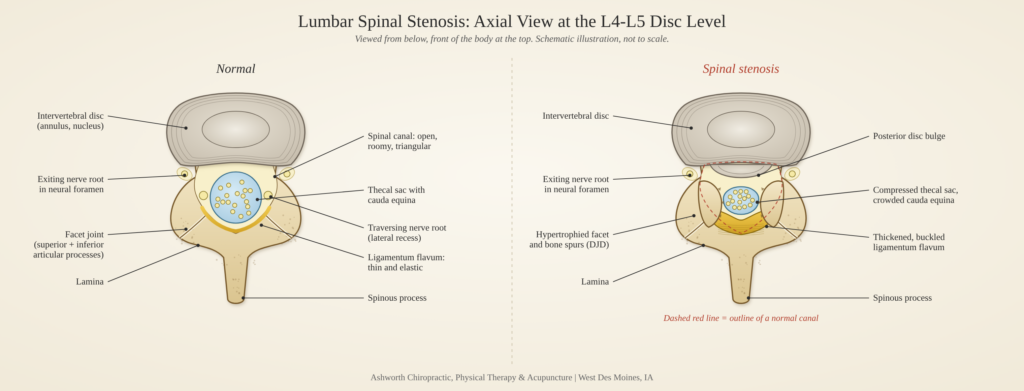
Lumbar spinal stenosis is a narrowing of the canal that carries the nerves down your low back. The typical story is leg heaviness, aching, or numbness when you stand or walk, and relief when you sit or lean forward on a shopping cart. One of the biggest contributors to the narrowing is the ligamentum flavum, a thick ligament at the back of the canal. When it thickens, the canal gets tighter.
Until recently nobody could say what was driving that thickening at the cell level. There was no medication aimed at it, which is part of why surgery has been the main medical answer for severe cases.
What the New Study Found
In September, researchers at Weill Cornell Medicine and the Hospital for Special Surgery published a paper in Cell (also covered by HSS and ScienceDaily) identifying the stem cell that builds tendon and ligament tissue throughout the body, in both mice and humans. According to the published abstract, when stenosis was induced in the mouse model, these cells were reprogrammed to produce more ligament-type cells, and that shift depended on calcium signaling. Press coverage reports that people with stenosis had more of these cells in their spinal ligaments than people with herniated discs but no stenosis.
The authors point to calcium channel blockers, drugs already used for blood pressure, as a possible treatment to investigate. They are clear that this needs human clinical trials first.
Here’s what that does and doesn’t mean. It is early science: mouse data plus human tissue samples. It does not mean a pill exists, and it does not mean anyone should ask their doctor to switch medications because of this paper. What it does give us is a real mechanism to look at, which is more than we had.
What Makes the Ligament Thicken in the First Place
The new paper identifies the cell and a calcium-dependent switch. It doesn’t, in the abstract or the press coverage available at the time of writing, settle what flips that switch. Other research gives strong hints, and they point at mechanical load.
- A 2014 study of human ligamentum flavum tissue found that stretching the ligament’s fibroblasts activated a calcineurin/NFAT pathway. That raised Angptl2, an inflammation signal, and then TGF-β1, a driver of fibrosis. Angptl2 levels tracked with ligament thickness and with how much motion the segment had. This was tissue from surgical patients and cell-culture work, not a trial.
- A 2025 study in Nature Biomedical Engineering found that fibrotic areas of human ligamentum flavum exposed to high stress showed elevated ROCK signaling and more myofibroblasts, the cells that lay down scar-like tissue.
- A 2025 rabbit model that concentrated mechanical stress at one spinal level produced ligament thickening, collagen buildup, and local inflammation within 12 weeks.
- A 2026 review proposes that Piezo1, a channel that opens under mechanical stress and passes calcium, may be involved in ligament hypertrophy. The review itself says the role is still unclear.
Put together, the pattern is that repeated mechanical stress on the ligament sets off calcium signaling, which sets off inflammation, which sets off fibrosis and thickening. Inflammation looks like a middle step in that chain, not a separate root cause. I want to be plain that nobody has run this whole chain end to end in one study. It’s a convergence across several, not a proven sequence.
Where My Clinical Read Fits, and Where It’s a Hypothesis
Almost every stenosis patient I see also has degenerative change in the posterior facet joints. I don’t think that’s a coincidence. My working hypothesis is that sustained or repeated loading into lumbar extension, and loss of trunk control that lets the lumbar spine hang into extension, is one of the stimuli that keeps loading that ligament and those joints. That would include the person who wakes up achy after sleeping in relative extension, the lifter who repeatedly loads under extension, and the lower crossed pattern with a weak deep abdominal wall.
It’s a hypothesis. It’s consistent with the mechanical research above, and it isn’t proven by it. Two findings keep me humble:
- A 2026 MRI study of 1,266 people with stenosis and 1,000 without found that ligament thickening in the lower lumbar spine came with disc and endplate degeneration, while thickening in the upper lumbar spine often happened without it. The authors concluded different mechanisms are at work in different places. Load is probably not the whole answer.
- A 2022 imaging study of 93 people with stenosis found more intervertebral motion and smaller multifidus, erector spinae, and psoas muscles compared with controls. That fits a stability story. It can’t tell us which came first.
Why “Sit Up Tall” Is Often the Wrong Advice
Most desk workers have been told to sit up straight. For a lot of people, that cue backfires. Most people don’t have much extension available in the upper thoracic spine, so when they try to sit tall, they get the height from the one place that will give it to them: the lumbar spine. They arch the low back to look upright. They’ve traded a posture problem in the upper back for a loading problem in the low back.
There’s some support for the first half of that. A small 2024 study of 29 healthy adults, using motion sensors, found that lumbar lordotic curvature was larger when people were told to sit upright than when they sat the way they normally do. It was a short test in healthy people, so it can’t tell us what years of it do. The rest is my clinical reasoning, not a finding:
- Sitting in lumbar extension for hours a day, every day, keeps loading the posterior facet joints and the ligament behind the canal. For a patient who already has stenosis, or a swayback or lower crossed pattern, I think that’s a plausible route to the facet degeneration nearly every stenosis patient shows.
- Sitting arched also leaves the front of the trunk “open.” The rib cage flares and the deep abdominal wall can’t hold a neutral position. The spinal stabilizers end up out of position and work poorly, which means the spine leans on its passive structures instead.
So I teach a more neutral spine in sitting. For many people, neutral looks a little slouchy, because they can’t extend through the upper thoracic spine to fake the tall posture. That’s not a flaw in the position. It’s an accurate picture of what their spine can currently do. The work is to restore the motion and control that make neutral comfortable, not to force an arch.
Your MRI Is Not the Diagnosis
A 2026 review of the immune markers in ligament hypertrophy reports that about 20% of people over 60 show lumbar stenosis on imaging, and more than 80% of them have no symptoms. A narrowed canal on a report and a patient who has symptoms from it are two different things. That is why I treat the person and the symptoms, not the picture. It’s also why “your MRI shows severe stenosis” should start a conversation about function, not end one.
What the Surgery-vs-Conservative-Care Evidence Shows
This is where conservative care earns its place, with limits.
In a 2015 Annals of Internal Medicine trial of nearly 170 patients with stenosis, people randomized to decompression surgery and people randomized to physical therapy twice a week for six weeks had equivalent pain and function at two years. The researchers noted surgical adverse events in the range of 15 to 20%, with about half of those serious. The catch is that more than half of the physical therapy group went on to have surgery during the study. Physical therapy worked for many people. It didn’t work for everyone.
A pooled analysis of nine randomized trials and 1,658 patients found no significant difference between surgery and conservative care at six months. Surgery looked better at one and two years in that analysis, with higher complication rates throughout. The authors didn’t find evidence supporting one definitive approach for everyone.
And surgery doesn’t work for everyone either. A 2026 secondary analysis of the NORDSTEN trials, which followed 704 surgical patients, found that nearly a third had an unsuccessful outcome. Radiating pain lasting longer than 12 months, psychological distress, and advanced disc degeneration were each linked to a worse result.
So the honest framing isn’t “avoid surgery.” It’s that conservative care is a reasonable first step for most people with stenosis, because it’s the least invasive and the evidence shows it competes well early on. It’s also not something to do indefinitely. A trial of conservative care should have a time window and clear criteria for when it isn’t working.
What We Do
Our treatment hierarchy applies here like everywhere else: least invasive first, quickest realistic outcome, least expensive, in that order.
The intake is the PRI-based functional exam we run on every new chiropractic patient. It looks at breathing mechanics, stance, and how the pelvis and trunk are organized, because in stenosis the question that matters is why the lumbar spine is spending so much time in the position that narrows the canal. From there, treatment is matched to what the exam shows, not to a fixed protocol. There’s no pre-set package, and you’re re-evaluated as we go.
For stenosis specifically, the work centers on getting the lumbar spine out of the position that narrows the canal and keeping it out of it. That means Cox Flexion-Distraction and PRI-based postural restoration that emphasizes spinal flexion and activation of the deep core and spinal stabilizers. It also means teaching you how to load your spine: the patterns you use in daily activities, how you lift, and for golfers, how the swing can be adjusted through the lens of spinal over-extension. I do not use high-velocity thrust manipulation on the lumbar spine in stenosis patients. I add nutritional anti-inflammatory support, and I go over positioning, because a lot of the standard ergonomic advice on how to hold your spine is outdated (more on that above).
Stenosis is a condition where some patients get meaningfully better with conservative care and some don’t, and I’d rather you hear that from me before you start than discover it later. When I’m not seeing progress, I say so and refer you on. That isn’t a failure of the process. It’s the process working.
When We Refer, and What Surgery Looks Like Now
My rule of thumb is six months. If you aren’t meaningfully better over about six months of well-directed care, it’s time to talk seriously about surgery. That doesn’t mean you’ll see us for six months. It means that’s the window I use to decide. Sometimes the problem resolves and surgery never becomes necessary. Sometimes stenosis turns into a management issue that I help you carry until surgery is the right move, and that is a legitimate outcome, not a failure.
My experience is that you shouldn’t be afraid of surgery for stenosis when it’s the right call, and outcomes are generally good. The research is a little more mixed than that, which is why the checkpoint matters: in the NORDSTEN analysis, nearly a third of surgical patients had an unsuccessful result, and a longer history of radiating pain was one of the factors linked to a worse one. Waiting indefinitely isn’t a free option either. And if you do have surgery and symptoms linger afterward, we can help with those, using the tools we have in house: shockwave, laser, PRI-based work, physical therapy, and acupuncture.
One option that has changed the conversation for a specific group of patients is TOPS, the Total Posterior Spine System, a facet joint replacement that preserves motion instead of fusing the segment. According to the FDA approval coverage, it was approved in June 2023 for grade 1 degenerative spondylolisthesis with stenosis, which is a forward slip of one vertebra over the one below it, combined with canal narrowing. It is not an option for every kind of stenosis, and that matters.
The evidence comes from a randomized trial across 37 sites that compared TOPS with decompression plus fusion, randomizing patients two to one. Patients had to have failed at least six months of nonsurgical treatment to be eligible, which is worth noticing: even the trial that put this device on the market started from the position that conservative care comes first. At three years, according to PubMed, the composite clinical success rate was 76.0% for TOPS and 56.8% for fusion. Reoperation or lumbar injection was less frequent with TOPS (14.0% vs 25.3%). Some measures didn’t differ significantly, including the overall Oswestry Disability Index, leg pain scores, and the Zurich Claudication Questionnaire, and the reoperation-failure rates were similar between groups.
Two honest caveats. First, this trial compared TOPS to fusion, not to conservative care, so it tells you which surgery did better, not whether you needed surgery. Second, access is still limited. Reporting from Becker’s Spine describes the device as carrying an unlisted Category III billing code with no assigned relative value units, which has slowed adoption at some hospitals. Whether it’s available, and whether your insurance will cover it, depends on where you are and who your surgeon is.
When You Should Skip Straight to a Surgical Consult or the ER
Honest triage works in both directions. These need prompt medical attention rather than a trial of conservative care: new or worsening leg weakness, foot drop, new loss of bladder or bowel control, or numbness in the saddle area. If you have any of these, don’t book a chiropractic visit first. Go to urgent care or the ER.
Common Questions
Can spinal stenosis be reversed without surgery? Nothing in the research so far shows that conservative care shrinks a thickened ligament. What the evidence supports is reducing symptoms and improving function, and in the 2015 trial that was comparable to surgery at two years for many patients. The new stem cell research is early and doesn’t change treatment today.
Is the new stem cell research going to lead to a drug? Possibly. The authors suggest calcium channel blockers as something to study. That needs human trials. Don’t change any medication based on this research without talking to your prescriber.
How many visits does spinal stenosis take? It varies more than it does for most conditions we treat, and I won’t give you a number I can’t back up. What I can say is that you shouldn’t be signing up for a long course of care without a clear checkpoint. Most people know within a few visits whether the approach is helping. If it isn’t, I’ll tell you and we’ll discuss next steps.
What is TOPS, and is it right for me? TOPS is an FDA-approved motion-preserving facet joint replacement for grade 1 degenerative spondylolisthesis with stenosis. It isn’t for every type of stenosis. Whether you’re a candidate is a question for a spine surgeon, and we can help you work out whether it’s worth asking.
What does the cost look like? No contracts and no pre-set packages. You pay for what you get. Details are on our cost of care page.
If you’ve been told you have stenosis and you’re weighing your options, a second set of eyes on what’s actually driving your symptoms is a reasonable next step. Call us at 515-225-4002 or book an evaluation. I’ll tell you plainly whether I think we’re the right fit.
References
- Hu L, et al. Identification of the tendon/ligament stem cell in mice and humans. Cell. 2026. DOI (abstract reviewed; full text not available at time of writing)
- Nakamura T, et al. Angiopoietin-like protein 2 induced by mechanical stress accelerates degeneration and hypertrophy of the ligamentum flavum in lumbar spinal canal stenosis. PLoS One. 2014. DOI
- ROCK-dependent mechanotransduction of macroscale forces drives fibrosis in degenerative spinal disease. Nat Biomed Eng. 2025. DOI
- Mechanical stress contributes to ligamentum flavum hypertrophy by inducing local inflammation and myofibroblast transition in the innovative surgical rabbit model. Front Immunol. 2025. PubMed
- Piezo1: Molecular mechanisms and therapeutic potential in ligamentum flavum hypertrophy and lumbar spinal stenosis. Redox Biol. 2026. DOI
- Differential Mechanisms of Ligamentum Flavum Hypertrophy: A Comparative MRI Analysis of Lumbar Spine Degeneration Patterns. Clin Spine Surg. 2026. DOI
- Age-related radiographic parameters difference between degenerative lumbar spinal stenosis patients and healthy people. J Orthop Surg Res. 2022. DOI
- The Main Immune Markers of Ligamentum Flavum Hypertrophy: A Narrative Literature Review. Int J Mol Sci. 2026. DOI
- Effectiveness of surgery versus conservative treatment for lumbar spinal stenosis: a systematic review and meta-analysis of randomized controlled trials. Int J Surg. 2017. PubMed
- Predictors for unsuccessful outcome of lumbar spinal stenosis surgery: secondary analysis of the NORDSTEN trials. Spine. 2026. PubMed
- Delitto A, et al. Surgery versus nonsurgical treatment of lumbar spinal stenosis. Ann Intern Med. 2015. HealthDay coverage
- Kim JC, et al. Assessing the preservation of lumbar lordotic curvature in everyday sitting conditions assessed with an inertial measurement system. J Clin Med. 2024. DOI
- VanHorn T, et al. Posterior lumbar facet arthroplasty versus fusion for the treatment of spondylolisthesis: 3-year results from the Total Posterior Spine System IDE study. Neurosurg Focus. 2026. DOI
- Coric D, et al. Prospective, randomized controlled multicenter study of posterior lumbar facet arthroplasty for the treatment of spondylolisthesis. J Neurosurg Spine. 2022. DOI
- TOPS FDA approval coverage: OrthoWorld; reimbursement coverage: Becker’s Spine
- Press coverage of the Cell paper: HSS, ScienceDaily, Becker’s Spine