


Neck Pain: Why It’s Rarely Just a Neck Problem
Most neck pain gets treated in the neck. Adjustments, stretching, massage, strengthening exercises — all directed at the cervical spine and the muscles around it. And most of the time, it helps. For a while.
Then it comes back.
The reason is straightforward: the neck is usually the compensator, not the cause. It’s the end of a chain that starts at the pelvis, runs through the thoracic spine and rib cage, and arrives at the cervical spine carrying whatever mechanical debt the system below has accumulated. Treat the neck in isolation and you’re treating the last link in the chain while everything driving the problem remains unchanged.
This doesn’t mean neck treatment isn’t valuable — it is. But it means the evaluation has to start further down than most providers look.
What the neck is actually dealing with
The cervical spine has one non-negotiable job above everything else: keep the eyes on the horizon.
This is a survival-level priority. Regardless of what’s happening in the pelvis, the thoracic spine, the rib cage, or the shoulders, the visual system demands that the head stay level and the eyes stay forward. The cervical spine will do whatever it takes to make that happen — and “whatever it takes” is where neck pain comes from.
Here’s what the cervical spine is adapting to:
Thoracic extension pattern. When the mid-thoracic spine is locked in extension — particularly at T3-T5, which is the most common pattern — the head is driven forward and down relative to the center of mass. To keep the eyes level, the upper cervical spine extends (the head tips back at the base of the skull) while the lower cervical spine flexes. This creates a double bend in the cervical curve: upper cervical extension stacked on lower cervical flexion. The result is forward head posture — not because the person is slouching, but because the cervical spine is compensating for what’s below it.
For every centimeter the head moves forward from its ideal position over the shoulders, the effective weight the cervical spine has to manage increases by approximately 4-5 kilograms. A head that is 5 centimeters forward is imposing roughly 20-25 kilograms of additional load on the cervical musculature and joints — all day, every day.
Rib cage position and breathing. When the rib cage is elevated and flared — the consequence of thoracic extension and poor breathing mechanics described on the mid-back pain page — the accessory breathing muscles of the neck are recruited to help lift the rib cage on inhalation. The scalenes, sternocleidomastoid, and upper trapezius become chronically overactive as secondary breathing muscles. These are the same muscles that produce the neck tightness and upper shoulder tension patients describe as “where I carry my stress.” The stress is real — but the mechanism is mechanical, not emotional.
Pelvic and thoracic asymmetry. The human body is not bilaterally symmetrical. The liver sits on the right. The left diaphragm is mechanically disadvantaged compared to the right. These structural asymmetries — a core concept of the Postural Restoration Institute (PRI) — create consistent, predictable rotational patterns through the pelvis and thoracic spine — and the head rotates and tilts in response. A pelvis that is rotated right and a thoracic spine that follows it produces a cervical spine that counter-rotates left to keep the eyes forward. This asymmetrical loading is why neck pain, jaw tension, and headache are so often one-sided — and why they recur on the same side after treatment if the underlying asymmetry hasn’t been addressed.
Lower cross syndrome. When the pelvis is in anterior tilt — hip flexors tight, glutes underactive, lumbar spine hyperextended — the entire spinal column above it is reorganized. The compensation chain runs from the pelvis through the lumbar spine, through the thoracic spine, and arrives at the cervical spine. Lower cross syndrome and chronic neck pain frequently coexist because they’re part of the same postural pattern, not separate problems.
Causes of neck pain — local and distant
Local causes — originating in the cervical spine itself
Cervical joint restriction — the most common chiropractic finding. One or more cervical joints lose their normal mobility, producing local pain and tenderness, restricted range of motion, and often referred pain into the shoulder and upper back. Headaches and jaw problems can result from restriction in the upper cervical spine specifically. Long-standing restrictions alter the mechanical environment of the cervical discs and facet joints.
Cervical disc herniation — disc material compressing a nerve root and producing radicular symptoms into the arm — pain, numbness, tingling, or weakness following a dermatomal pattern. C5-C6 and C6-C7 are the most commonly affected levels, producing symptoms into the shoulder, arm, forearm, and hand.
Cervical degeneration — gradual loss of disc height, bone spur formation, and foraminal narrowing over time. More common in adults over 50. Often asymptomatic or minimally symptomatic for years before producing significant nerve root compression.
Acute muscle strain — from sudden overload, awkward position during sleep, or the acceleration-deceleration mechanism of whiplash. Muscle strain heals relatively quickly with appropriate care; the joint restriction and movement pattern changes that accompany it are what tend to persist.
Upper cross syndrome — the overactivation of the upper trapezius, levator scapulae, pec minor, and sternocleidomastoid combined with underactivation of the deep cervical flexors and lower trapezius. This pattern produces neck pain, shoulder blade dysfunction, and forward head posture and is one of the most common presentations in desk workers and anyone who spends significant time looking at screens.
Distant causes — originating below the neck
Thoracic restriction — as described above, the most common and most commonly missed contributor to recurrent neck pain. The cervical spine compensates for lost thoracic rotation by rotating more itself. The upper cervical spine extends to compensate for mid-thoracic extension. Addressing the thoracic restriction is often what makes neck treatment stick.
Rib restriction and rib subluxation — the costovertebral joints attach to the thoracic spine, and restricted or subluxated ribs alter thoracic mechanics, which alters cervical loading. First rib restriction specifically — where the first rib is elevated and anterior — is a direct contributor to scalene tension and upper trapezius overactivation.
Pelvic asymmetry — rotational patterns through the pelvis that propagate upward through the thoracic spine and into the cervical spine. This is why a thorough neck pain evaluation should include an assessment of pelvic position and lumbopelvic mechanics, not just the cervical spine.
Scapular dyskinesis — the shoulder blade depends on the rib cage shape below it and the cervical spine above it for correct positioning. When the scapula is poorly positioned — winged, anteriorly tilted, or asymmetrically elevated — the muscles connecting it to the cervical spine (levator scapulae, upper trapezius) are chronically loaded. Neck pain and shoulder dysfunction frequently coexist for this reason.
Symptoms — what neck problems produce
Local symptoms:
- Neck pain and stiffness — often worse in the morning or after sustained postures
- Restricted range of motion — particularly rotation and lateral flexion
- Muscle tension in the upper trapezius and the base of the skull
- Clicking, grinding, or catching with neck movement
- Pain that worsens with sustained flexion (looking down at a phone) or extension (looking up)
Referred and downstream symptoms:
Cervicogenic headache — headache originating from the cervical spine, typically presenting as a unilateral ache starting at the base of the skull and radiating forward toward the eye or temple. Often accompanied by neck stiffness and shoulder tension. Provoked by neck movement or sustained postures. Frequently misdiagnosed as tension headache or migraine. If your headaches consistently start in the neck or are associated with neck stiffness, cervicogenic headache is the likely diagnosis and responds well to cervical chiropractic care.
Cervical radiculopathy — nerve root compression producing pain, numbness, tingling, or weakness into the shoulder, arm, forearm, or hand. The pattern of symptoms identifies which nerve root is involved. See the radicular pain page for a full explanation.
TMJ dysfunction — jaw pain, clicking, locking, or difficulty chewing associated with cervical dysfunction. The connection is anatomical and well-documented. Several muscles that attach to the cervical spine and skull base are directly involved in jaw movement — the suprahyoid and infrahyoid muscles, the digastric, the sternocleidomastoid. When the upper cervical spine is in a compensatory overextended position, these muscles are chronically loaded and their resting tension changes the way the jaw closes and the temporomandibular joint loads.
Forward head posture changes the resting position of the mandible. As the head migrates forward, the jaw drops slightly — the mouth wants to open. To maintain occlusion (teeth together in normal bite), the muscles of mastication work harder. Over time this produces jaw fatigue, clicking, pain with chewing, and the morning jaw tightness that many people dismiss as stress. The stress is real — the mechanism is postural.
Naomi Hooper, LMT at our clinic specializes in TMJ-focused soft tissue work, which addresses the masseters, pterygoids, and the cervical attachments that contribute to TMJ loading. When cervical dysfunction and jaw dysfunction coexist — which is most of the time — addressing both simultaneously produces better results than treating either in isolation.
Cervical vertigo — dizziness and balance disturbance originating from disrupted proprioception in the cervical spine. The cervical spine contains a high density of proprioceptive receptors that contribute significantly to the body’s sense of position and movement. When cervical joint restriction disrupts that proprioceptive input, the vestibular system and visual system receive conflicting information — producing dizziness, unsteadiness, and sometimes nausea. Cervical vertigo is distinct from inner ear vertigo (BPPV) and responds to cervical treatment rather than repositioning maneuvers.
Shoulder and breathing symptoms — because several cervical muscles attach to the upper ribs and scapula, chronic cervical tension affects shoulder mobility and breathing pattern. The scalenes — which run from the cervical spine to the first and second ribs — are primary accessory breathing muscles when the diaphragm isn’t working efficiently. Their chronic overactivation in cervical dysfunction patients contributes to both the shoulder tension and the breathing pattern problem simultaneously.
When the neck becomes the driver — chronic pain and neurological wind-up
Everything described above positions the neck as a compensator — the end of a chain that starts below. That’s accurate for most acute and subacute neck pain presentations. But there’s an important exception that changes the clinical picture significantly.
When neck pain has been present for months or years, the nervous system adapts. The repeated nociceptive input from chronically restricted cervical joints, overloaded muscles, and compressed nerve roots doesn’t stay localized — it sensitizes the central nervous system. Neurons in the spinal cord and brain that process pain signals from the cervical spine become increasingly responsive, requiring less and less stimulation to fire. This is central sensitization — and once it develops, the neck stops being a passive compensator and becomes an active pain generator.
At this point the clinical picture reverses. The cervical spine, which was originally responding to patterns below it, is now sending its own signals downward. Patients with long-standing cervical dysfunction frequently develop:
- Shoulder and upper extremity symptoms that migrate and fluctuate without a clear structural explanation — because they’re driven by sensitized central pathways, not purely by local tissue damage
- Thoracic pain and stiffness that seems to follow the neck problem rather than precede it — the descending pain referral from sensitized cervical structures
- Altered breathing patterns as the chronic upper cervical tension and accessory muscle overactivation become self-perpetuating rather than secondary to rib cage position
- Widespread sensitivity — patients who become tender in areas anatomically unrelated to the neck, because the sensitized nervous system has expanded its pain map
- Cognitive and mood changes — difficulty concentrating, irritability, sleep disruption — that accompany central sensitization in chronic pain states
This is also why some patients with genuine thoracic restriction and pelvic asymmetry driving their neck pain don’t fully resolve when those patterns are corrected. The downstream correction is necessary but not sufficient — the sensitized cervical nervous system needs direct treatment as well.
Clinically, chronic neck pain requires a different approach than acute neck pain. Aggressive manual therapy to a sensitized cervical spine can amplify symptoms rather than reduce them. The sequence matters: reducing the neurological sensitivity first — through acupuncture, gentle mobilization, soft tissue work, and in some cases functional medicine evaluation for inflammatory drivers — before loading the system with the corrective work that addresses the structural and postural patterns.
Acupuncture is particularly useful here. The evidence for acupuncture in central sensitization and chronic cervical pain is meaningful — not because it corrects structure, but because it modulates the central pain pathways that have become the primary driver. Combined with gentle cervical and thoracic mobilization, it can reduce the neurological amplification enough that the postural and mechanical work can proceed effectively.
The practical implication: if you’ve had neck pain for years, the path back is not necessarily the same as for someone who developed neck pain six weeks ago. The evaluation needs to account for the neurological dimension, not just the mechanical one.
Why it keeps coming back
The single most common reason neck pain recurs after treatment is that the treatment addressed the cervical spine without addressing what’s driving it.
If the thoracic spine is restricted and the cervical spine is compensating for that restriction, cervical manipulation provides relief — but the thoracic restriction is still there. The cervical spine will return to its compensatory position because the demand driving that position hasn’t changed.
If the rib cage is elevated and flared, and the scalenes and upper trapezius are recruited as accessory breathing muscles 20,000 times a day, soft tissue work provides relief — but the breathing pattern and rib cage position are unchanged. The muscles return to their overactive state because they’re still being recruited to do the job the diaphragm can’t do from a poorly positioned rib cage.
If the pelvis is rotated and the thoracic spine is following it, and the cervical spine is counter-rotating to keep the eyes forward — treating the neck alone is chasing the last link in a chain that starts at the pelvis.
This is why a thorough evaluation matters more than starting treatment fast. Identifying which of these patterns is present, in what combination, and what’s primary versus secondary — that determines whether treatment sticks or whether the same patient comes back with the same problem six months later.
How we approach neck pain at Ashworth
The evaluation includes assessment of the cervical spine — range of motion, joint mobility, neurological screen, provocative testing — but it doesn’t stop there. We look at thoracic mobility, rib cage position, breathing pattern, scapular positioning, and lumbopelvic mechanics. The Postural Restoration Institute (PRI) framework gives us a model for understanding how asymmetrical patterns propagate through the spine — which is why we often find pelvic and thoracic findings in patients who come in with neck pain, and why addressing those findings is part of what makes the cervical treatment work long-term. Dr. Wilson has completed the full PRI curriculum and sits for the Postural Restoration Certified (PRC) examination in December 2026.
Treatment depends on what the evaluation finds:
- Chiropractic care — specific to the restricted cervical and thoracic segments. Not a generic “neck adjustment” — technique and direction matched to the finding
- Soft tissue work — addressing the cervical musculature, scalenes, suboccipitals, and upper trapezius directly. Combined with massage for TMJ presentations
- Acupuncture — effective for cervicogenic headache, upper cervical tension, and the central sensitization component of chronic neck pain
- Breathing mechanics rehabilitation — restoring diaphragmatic breathing and rib cage position to remove the chronic mechanical demand on the cervical accessory muscles
- Postural and movement rehabilitation — restoring thoracic rotation, correcting the patterns that are loading the cervical spine from below
Most patients with uncomplicated cervical restriction resolve quickly — often within 3–6 visits. Chronic neck pain with significant postural or thoracic drivers takes longer but responds well to the combined approach.
If you’re in West Des Moines or the greater Des Moines area, reach us at (515) 225-4002 or schedule an appointment online. No referral needed.
Frequently asked questions
What causes neck pain?
Neck pain most commonly comes from joint restriction, muscle guarding, or disc irritation in the cervical spine. But the origin is frequently below the neck — thoracic restriction, rib cage position, pelvic asymmetry, and breathing pattern all influence how the cervical spine loads. Treating the neck without looking at what’s driving it from below is one of the main reasons neck pain keeps coming back.
Can neck pain cause headaches?
Yes. Cervicogenic headache — headache originating from the cervical spine — typically presents as a unilateral ache starting at the base of the skull and radiating forward. It’s provoked by neck movement or sustained postures and is frequently misdiagnosed as tension headache or migraine. Chiropractic care addressing the upper cervical spine is one of the most effective treatments for this type of headache.
Can neck problems cause jaw pain?
Yes. Several muscles involved in jaw movement attach to the cervical spine and skull base. Forward head posture changes the resting position of the mandible and loads the TMJ asymmetrically. TMJ dysfunction and cervical dysfunction frequently coexist and usually respond better when addressed together.
Why does my neck pain keep coming back?
Because the neck is usually the compensator, not the cause. Thoracic restriction, rib cage position, pelvic asymmetry, and breathing mechanics all place chronic mechanical demand on the cervical spine. If those patterns aren’t assessed and addressed, neck treatment provides temporary relief but the underlying load remains. The neck returns to the same stressed position because the system driving it there hasn’t changed.
Can poor posture cause neck pain?
Yes — but forward head posture is usually a compensation for what’s happening below, not a habit to correct in isolation. Thoracic extension pattern, rib flare, and pelvic position push the head forward as the body keeps the eyes on the horizon. Correcting the posture without addressing what’s driving it produces temporary improvement at best.
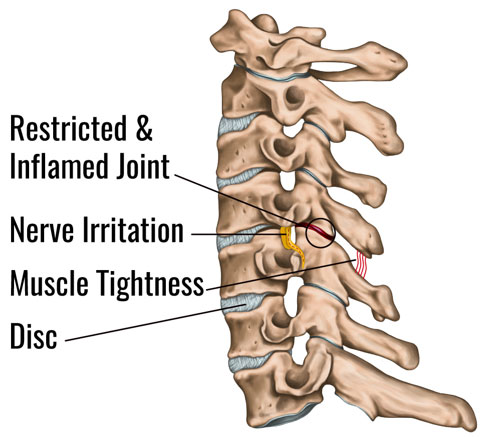
Image on this page provided by ChiroUp.
Coordinated Care, Under One Roof
Chiropractic care, physical therapy, acupuncture, massage, shockwave therapy, and functional medicine are coordinated under one roof, so a patient who needs more than one discipline is not left to manage care between separate offices. Each provider works from the same diagnosis, in the right sequence, toward the same goal: getting you better.