


Shockwave Therapy for Rotator Cuff Pain & Calcific Shoulder: 1,093 Patients. 16 Clinical Trials. Here’s What the Research Found.
By Dr. Matthew Wilson, DC, FIACA | Ashworth Chiropractic, Physical Therapy & Acupuncture | West Des Moines, Iowa
Shoulder pain has a way of quietly taking over. You stop reaching overhead. You sleep on the other side. You modify everything — how you carry groceries, how you put on a jacket, how you swing a golf club — until the modifications become just how you live.
A lot of that shoulder pain comes from the rotator cuff. The four muscles and their tendons that make up the rotator cuff are responsible for stabilizing and moving the shoulder joint. They are also among the most commonly injured structures in the upper body — and one of the most undertreated, because chronic rotator cuff pain has a reputation for being stubborn.
That reputation is partly deserved. But it’s changing — and shockwave therapy is a big part of why.
Rotator Cuff Tendinopathy — What’s Actually Going On
The rotator cuff tendons are subject to repetitive mechanical stress with virtually every overhead or pushing movement you make. Over time — or after a specific injury — those tendons can develop tears, degeneration, and a chronic failure to repair.
The result is tendinopathy: a state where the tendon tissue has become structurally compromised. Collagen fibers become disorganized. The tendon loses its normal architecture. Blood supply decreases. The body stops mounting an effective repair response.
Pain, weakness, and limited range of motion follow. And because the shoulder is involved in virtually every upper body movement, the functional impact is significant.
For some patients, there is an additional complication: calcium deposits form in the rotator cuff tendons — a condition called calcific tendinitis. These deposits can range from small and incidental to large and acutely painful. They represent a specific subtype of rotator cuff pathology that responds particularly well to focused shockwave therapy.
Two distinct presentations — one effective treatment: Whether you have rotator cuff tendinopathy without calcification, or calcific tendinitis with visible calcium deposits on imaging, shockwave therapy has well-documented clinical evidence for both.
How Shockwave Therapy Works for the Shoulder
The Storz Medical Duolith SD1 Ultra delivers focused acoustic energy precisely to the affected tendon tissue. For rotator cuff tendinopathy, the mechanisms are the same as for other degenerative tendon conditions:
- Stimulates neovascularization — new blood vessel formation — restoring circulation to tissue that has become ischemic
- Triggers collagen synthesis and tendon remodeling, replacing disorganized degenerated tissue with structurally organized repair
- Reduces substance P and other pain-signaling neuropeptides — providing meaningful pain relief alongside the structural repair
- Activates stem cell recruitment and the body’s own regenerative repair process
For calcific tendinitis specifically, focused shockwave has an additional mechanism: the acoustic energy mechanically disrupts the calcium deposits within the tendon, breaking them down and facilitating their reabsorption by the body. This is one of the most well-studied applications of ESWT in the shoulder literature.
What the Clinical Research Shows
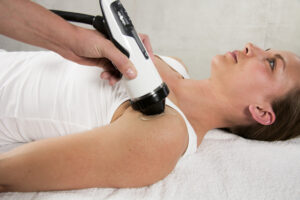
Shockwave Therapy Treatment for Shoulder Pain
Based on articles retrieved from PubMed, here is what the peer-reviewed literature tells us — starting with the most comprehensive evidence to date:
16 RCTs, 1,093 Patients — 3.64x More Effective Total Recovery Rate
A 2024 systematic review and meta-analysis published in BMC Musculoskeletal Disorders (Xue et al.) is the most comprehensive analysis of ESWT for rotator cuff tendinopathy to date. It analyzed 16 randomized controlled trials covering 1,093 patients with rotator cuff tendinopathy — both calcific and non-calcific presentations.
The findings are compelling across every measured outcome:
- Total effective recovery rate: 3.64 times higher in the ESWT group compared to control (OR = 3.64, 95% CI 1.85–7.14, p = 0.0002)
- Pain (Visual Analogue Scale): Significantly reduced in the ESWT group (p < 0.00001)
- Shoulder function (Constant-Murley Score): Significantly improved (p < 0.00001)
- UCLA shoulder score: Significantly improved (p < 0.00001)
- ASES shoulder score: Significantly improved (p < 0.00001)
- External rotation range of motion: Significantly improved (p = 0.02)
The authors concluded that ESWT provides better pain relief, functional recovery, and maintenance of function in patients with rotator cuff tendinopathy compared to control groups.
Xue X, et al. Effect of extracorporeal shockwave therapy for rotator cuff tendinopathy: a systematic review and meta-analysis. BMC Musculoskelet Disord. 2024;25(1):357. DOI: https://doi.org/10.1186/s12891-024-07445-7
27 Studies, 2,212 Patients — ESWT Recommended as First-Line Before Surgery
A 2023 systematic review and meta-analysis published in the Journal of Shoulder and Elbow Surgery (Angileri et al.) reviewed 27 studies covering 2,212 patients with calcific tendinitis of the rotator cuff, comparing operative and non-operative interventions including ESWT, ultrasound-guided needling, and surgery.
Key finding: both ESWT and needling produced clinically significant improvements in pain and function. The authors concluded it is reasonable to trial ESWT as a first-line treatment before considering surgical intervention. For patients who are weighing whether to pursue surgery for a calcific shoulder — this is an important data point.
Angileri HS, et al. Chronic calcific tendonitis of the rotator cuff: a systematic review and meta-analysis of randomized controlled trials comparing operative and nonoperative interventions. J Shoulder Elbow Surg. 2023;32(8):1746-1760. DOI: https://doi.org/10.1016/j.jse.2023.03.017
Head-to-Head: ESWT vs. Needling at 1 Year
A randomized controlled trial published in Arthroscopy (Louwerens et al., 2020) enrolled 82 patients with symptomatic calcific tendinitis who had not responded to conservative treatment and compared high-energy ESWT against ultrasound-guided needling combined with a corticosteroid injection. At 1-year follow-up, both groups showed significant improvement in pain and shoulder function with high patient satisfaction rates. ESWT produced comparable functional improvement to the needling group, with no significant difference in functional outcome scores between the two treatments at one year.
The practical implication: ESWT produces outcomes equivalent to needling combined with cortisone — without the injection, without the procedural complexity, and without the corticosteroid.
Louwerens JKG, et al. Comparing Ultrasound-Guided Needling Combined With a Subacromial Corticosteroid Injection Versus High-Energy Extracorporeal Shockwave Therapy for Calcific Tendinitis of the Rotator Cuff. Arthroscopy. 2020;36(7):1823-1833. DOI: https://doi.org/10.1016/j.arthro.2020.02.027
The numbers in context: A 3.64x higher total effective recovery rate across 16 trials and 1,093 patients is not a marginal difference. It is a clinically meaningful finding from some of the highest-quality evidence in the shoulder literature. And the 2023 review recommends ESWT as a first-line option before surgery is even considered.
Calcific Tendinitis — When There’s a Calcium Deposit Involved

6 months and 6 visits later calcium deposit is largely reabsorbed. Pain free range of motion and function restored.

Initial radiograph showing a large calcium deposit in the shoulder joint with pain and accompanying loss of range of motion and function.
Calcific tendinitis of the rotator cuff affects roughly 7 to 17 percent of people with shoulder pain — a significant number who are often told their only options are injections or surgery. That’s not accurate.
The calcium deposits that form in the rotator cuff tendons can cause significant pain and functional limitation, particularly during the reabsorptive phase when the deposit becomes fluid and the surrounding tissue becomes acutely inflamed. Patients sometimes describe this as among the worst pain they’ve experienced.
Focused shockwave therapy is one of the few non-invasive treatments that directly addresses the calcification. The acoustic energy delivered by the Storz Duolith SD1 Ultra mechanically disrupts the calcium deposit and stimulates the body’s natural processes to reabsorb it. Multiple randomized controlled trials have documented both radiographic reduction in deposit size and significant clinical improvement in pain and function.
It won’t eliminate every deposit completely in every patient — we won’t promise that. But the evidence for meaningful improvement is strong, and the 2023 Journal of Shoulder and Elbow Surgery review supports ESWT as a first-line option before needling or surgery for this specific condition.
Who Gets Rotator Cuff Pain — and Who We See
Rotator cuff tendinopathy is not just an athlete’s injury. We see it in:
- Overhead workers — painters, construction workers, electricians, HVAC technicians
- Desk workers — particularly those with forward head posture and rounded shoulders that alter rotator cuff mechanics
- Athletes — baseball, softball, tennis, swimming, golf, volleyball, and CrossFit all generate significant rotator cuff load
- Older adults — rotator cuff degeneration is common with age and significantly impacts quality of life
- Anyone who had a sudden injury followed by chronic pain that never fully resolved
Calcific tendinitis specifically tends to affect people between 40 and 60, and is more common in women than men. But it can occur at any age and in any activity level.
What to Expect at Ashworth Chiropractic
Every shoulder patient starts with a thorough evaluation. We want to understand the duration and nature of your symptoms, your imaging history if available, what you’ve already tried, and what your functional goals are.
If shockwave therapy is appropriate for your shoulder:
- 3 to 6 focused shockwave sessions, spaced 1 to 2 weeks apart — calcific presentations may benefit from the higher end of that range
- Sessions are 5 to 15 minutes — no anesthesia, no recovery time required
- The Storz Medical Duolith SD1 Ultra with Sepia focused handpiece — true focused shockwave, reaching the rotator cuff at depth with precision
- Shockwave is often combined with physical therapyto address the postural, strength, and movement factors that contribute to rotator cuff loading — treating both the injury and its cause
For patients with calcific tendinitis, we’ll discuss what to expect regarding the calcium deposit specifically — including the realistic timeline for radiographic change and what clinical improvement typically looks like in the weeks following treatment.
The Role of Physical Therapy in Shoulder Recovery
Shockwave therapy addresses the damaged tissue. Physical therapy addresses what’s driving the damage — and for the shoulder, that’s almost always a combination of things: postural alignment, scapular mechanics, rotator cuff strength imbalances, and thoracic mobility.
Kelly Brown Gross, PT, MPT, WCS brings over 20 years of orthopedic physical therapy experience to every shoulder patient she works with. She sees one patient at a time, builds individualized rehabilitation programs, and works directly alongside Dr. Matt for patients whose rotator cuff condition requires both tissue repair and functional rehab.
The combination of focused shockwave and targeted physical therapy is more effective than either alone — and getting your shoulder right the first time is significantly better than going through it twice.
Questions We Hear Most
I’ve been told I need surgery for my shoulder. Should I try shockwave first?
That depends on what specifically is going on with your shoulder — but for rotator cuff tendinopathy and calcific tendinitis, the 2023 Journal of Shoulder and Elbow Surgery review explicitly recommends trialing ESWT before surgery. This is not a fringe opinion — it’s the recommendation from a major peer-reviewed orthopedic journal based on 27 studies. We’d encourage you to at least have a conversation with us before committing to an operating room.
I have a partial rotator cuff tear. Can shockwave help?
Partial tears are a nuanced area. The evidence is strongest for tendinopathy without full structural tear, but there is emerging support for ESWT in the context of partial tears as well — particularly for the pain and functional limitation associated with them. We’ll be honest with you at your evaluation about what’s appropriate for your specific imaging findings.
How long before I see results?
Most patients with rotator cuff tendinopathy begin noticing meaningful improvement within 3 to 4 sessions. For calcific tendinitis, the clinical response — reduced pain, improved function — often precedes the radiographic reduction of the calcium deposit, which can continue to change over weeks to months following treatment.
Do I need a referral?
No referral is needed for chiropractic evaluation at Ashworth Chiropractic. Iowa is also an open-access state for physical therapy — so if Kelly’s involvement is part of your plan, you can come directly to us without a physician referral for either service.
Is this covered by insurance?
Most insurance carriers don’t cover ESWT. At $200 per session for 3 to 6 sessions, most patients find it meaningfully more cost-effective than a surgical consultation, pre-op workup, procedure, and post-surgical physical therapy — particularly given the strong evidence for non-operative outcomes.
If you’re ready to find out whether you’re a candidate, visit our shockwave therapy service page for full details
Clinical References
The following peer-reviewed studies were retrieved from PubMed and cited in this article.
- Xue X, et al. Effect of extracorporeal shockwave therapy for rotator cuff tendinopathy: a systematic review and meta-analysis. BMC Musculoskelet Disord. 2024;25(1):357. DOI: https://doi.org/10.1186/s12891-024-07445-7
- Angileri HS, et al. Chronic calcific tendonitis of the rotator cuff: a systematic review and meta-analysis of randomized controlled trials comparing operative and nonoperative interventions. J Shoulder Elbow Surg. 2023;32(8):1746-1760. DOI: https://doi.org/10.1016/j.jse.2023.03.017
- Louwerens JKG, et al. Comparing Ultrasound-Guided Needling Combined With a Subacromial Corticosteroid Injection Versus High-Energy Extracorporeal Shockwave Therapy for Calcific Tendinitis of the Rotator Cuff: A Randomized Controlled Trial. Arthroscopy. 2020;36(7):1823-1833. DOI: https://doi.org/10.1016/j.arthro.2020.02.027
About the Author
Dr. Matthew Wilson, DC, FIACA, CCWP is the owner and lead clinician at Ashworth Chiropractic, Physical Therapy & Acupuncture in West Des Moines, Iowa. He is a Palmer College of Chiropractic honors graduate with advanced certifications in Graston Technique, Postural Restoration, functional medicine, acupuncture, laser therapy, and dry needling. He selected the Storz Medical Duolith SD1 Ultra specifically because it is the device most represented in the high-quality clinical literature — the same technology that produced the outcomes documented in the studies referenced in this article.