


Why Chiropractic Isn’t Working — And How Integrated Care Changes That
By Dr. Matthew Wilson, DC, FIACA | Ashworth Chiropractic, Physical Therapy & Acupuncture | West Des Moines, Iowa
Most clinics do one thing. They do it reasonably well. And when they hit the edge of what they can offer, they send you somewhere else — if they send you anywhere at all.
You’ve probably experienced this. You see the chiropractor for your back. They help, but something’s still off. Your doctor refers you to physical therapy. The PT helps, but the underlying structural issue keeps reasserting itself. Someone mentions acupuncture. You try massage. Each thing helps a little. But nobody is looking at the whole picture — and nobody is talking to each other.
That’s the gap we built Ashworth Chiropractic around closing.
We call it the Ashworth Integrated Model — AIM. It’s not a marketing phrase. It’s a clinical philosophy that shapes every decision we make about how to care for patients. And it’s why patients who have been to multiple other providers and plateaued tend to get different results here.
What the Ashworth Integrated Model Actually Is
AIM is simple in concept: every service we offer — chiropractic, physical therapy, acupuncture, massage therapy, shockwave therapy, laser therapy, and functional medicine — is available under one roof, delivered by providers who communicate with each other, and organized around a single question:
What does this patient specifically need, in what order, to get better as quickly and completely as possible — and stay that way?
That question sounds obvious. But it’s surprisingly rare in practice. Most clinics are organized around their services — what they offer — rather than around the patient’s needs. AIM reverses that. We start with you: your condition, your history, your goals, your life. Then we match the right combination of tools to what you actually need.
Sometimes that’s chiropractic alone. Sometimes it’s physical therapy alone. Often it’s a combination — and that combination changes as you move through your recovery.
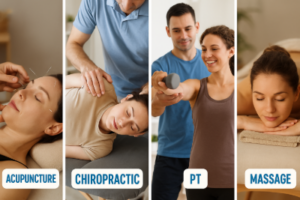
Combined Care Works Better, Faster.
Why Single-Discipline Care Often Falls Short
This is worth being direct about, because it explains why so many patients come to us after months or years of trying other things.
The human body is not a collection of isolated parts. Pain in one area is almost always connected to dysfunction in another. The shoulder that keeps going out is related to the thoracic spine that doesn’t rotate. The knee that keeps flaring is related to the hip that doesn’t extend. The headache that returns every week is related to the cervical spine, the upper trapezius, the jaw, the sleep position.
A single discipline sees through a single lens. A chiropractor sees the spine and joints. A physical therapist sees the movement and muscle function. An acupuncturist sees the meridian system and inflammatory response. A massage therapist sees the soft tissue.
Each of those lenses reveals something true. But none of them reveals everything. And treating what one lens shows while ignoring what the others would reveal often produces partial results — improvement that plateaus, relief that doesn’t last, problems that keep coming back.
The Insight Behind AIM
Your body doesn’t recover in disciplines. It recovers as a whole system. The question isn’t which discipline is right for your condition — it’s which combination of tools, applied in the right order, addresses your condition as a whole system.
The Team Behind AIM
AIM works because of who is in the room — and because those people actually coordinate care rather than working in silos.
Dr. Matthew Wilson, DC, FIACA, CCWP — Chiropractic, Acupuncture & Functional Medicine
Dr. Wilson is a Palmer College of Chiropractic honors graduate with advanced training in Graston Technique M1, Postural Restoration (PRI), acupuncture, dry needling, low-level laser therapy, and functional medicine. He holds a Fellowship in Acupuncture (FIACA) and is a Certified Chiropractic Wellness Practitioner (CCWP). His functional medicine training allows him to look beyond the musculoskeletal system when the clinical picture calls for it — evaluating hormones, gut health, inflammation, and metabolic factors that can contribute to pain, slow recovery, or treatment resistance.
Kelly Brown Gross, PT, MPT, WCS — Physical Therapy & Pelvic Health
Kelly holds the Women’s Health Certified Specialist (WCS) designation — one of fewer than 700 in the United States, and one of only about five in Iowa. She brings over 20 years of orthopedic and pelvic health physical therapy experience to every patient she sees — one at a time, every visit. Kelly has received referrals from Mayo Clinic and the University of Iowa Hospitals and Clinics for complex pelvic floor cases, and works seamlessly with Dr. Wilson for patients whose conditions benefit from combined chiropractic and PT care.
Naomi Hooper, LMT — Deep Tissue & TMJ Massage Therapy
Naomi is a Licensed Massage Therapist with specialized training in TMJ dysfunction — one of the most underserved areas in manual therapy. Her deep tissue work addresses the soft tissue component of musculoskeletal conditions, releases chronic muscle tension, and supports recovery from both chiropractic and physical therapy treatment.
Shannon Barnes, LMT — Therapeutic Massage
Shannon brings over 20 years of personalized massage therapy experience. Her work ranges from therapeutic recovery massage to stress-related tension management, and is integrated into care plans for patients where soft tissue work accelerates the overall outcome.
How AIM Works in Practice — Real Examples
The Patient With Chronic Low Back Pain
They’ve been to another chiropractor. They feel better for a day or two after each adjustment and then reset. What’s missing is the physical therapy component — the pelvic stability, the hip strength, the movement patterns that determine whether the spine stays in alignment or goes right back out. At Ashworth, Dr. Wilson addresses the structural component while Kelly identifies and corrects the movement dysfunction. Laser therapy accelerates soft tissue healing in the chronic areas. The result holds — because we addressed the system, not just the symptom.
The Patient With a Calcific Shoulder
They’ve had cortisone. It helped for six weeks. The calcium deposit is still there and the shoulder is still limited. Shockwave therapy breaks down the deposit and stimulates tissue repair. Chiropractic care restores mobility in the thoracic spine and cervical spine that has compensated around the shoulder. Physical therapy rebuilds the rotator cuff strength and scapular mechanics that will keep it stable. Three disciplines. One coordinated plan. One outcome.
The Postpartum Patient
She had her baby eight months ago. Her back still hurts. She leaks when she exercises. Her core feels disconnected. Her OB cleared her at six weeks. Kelly addresses the pelvic floor and diastasis recti. Dr. Wilson treats the lumbar and pelvic alignment that shifted during pregnancy. Massage therapy releases the chronic tension that built up in her upper back from nursing and carrying. She leaves with a complete picture of what’s happening in her body — and a plan that addresses all of it.
The Technology Layer — Shockwave and Laser
AIM now includes two regenerative technologies that extend what the clinical team can achieve:
- Storz Medical Duolith SD1 Ultra (ESWT) — focused shockwave therapy for chronic tendon conditions, calcific deposits, soft tissue injuries, and non-healing wounds. The gold standard device, and the only one in Iowa.
- Red light and low-level laser therapy — accelerates tissue healing, reduces inflammation, and enhances recovery from both chiropractic and physical therapy treatment. Often combined with shockwave in a single session for maximum regenerative effect.
These technologies don’t replace clinical care — they amplify it. A shockwave session that is followed by specific physical therapy exercises produces better results than shockwave alone. Laser therapy that supports an adjustment accelerates recovery time. The technologies and the clinical care are designed to work together — because that’s what AIM means.
What Makes This Different From a Multi-Specialty Building
A lot of medical complexes have multiple providers under one roof. That’s not the same as integrated care.
At Ashworth, the providers communicate. When Dr. Wilson sees something in your chiropractic evaluation that he believes Kelly needs to know about, he tells her. When Kelly sees a movement pattern or pelvic floor finding that has implications for your chiropractic care, it gets factored in. The care plan is built together — not in separate silos that happen to share a zip code.
We also have a unified philosophy: get you better in as few visits as possible, give you the tools to stay that way, and not sell you services you don’t need. No packages. No pressure. No endless maintenance plans. The goal of AIM is to make you independent — not dependent on us.
The last thing we want to say to every patient is: ‘I’m glad you’re feeling better — and that we could give you the tools to stay out of here.’ That’s not a tagline. It’s the whole point.
Who Benefits Most From Integrated Care
AIM is not for everyone — some patients come in with a straightforward acute issue that resolves quickly with one discipline. But integrated care is particularly valuable for patients who:
- Have been dealing with a problem for months or years and plateaued with other treatment
- Have seen multiple providers without getting a complete picture of what’s driving their condition
- Have a complex presentation that involves both structural and functional components
- Want to address the root cause rather than manage symptoms indefinitely
- Are preparing for or recovering from surgery and want to optimize both sides of that process
- Have a chronic condition — tendinopathy, pelvic floor dysfunction, functional medicine issues — that requires a sustained, multi-faceted approach